
Search
Remove Ads
Advertisement
Search Results

Definition
Urartu Art
The art produced by the Urartu civilization, which flourished in ancient Armenia, eastern Turkey, and northwestern Iran from the 9th to 6th century BCE, is best seen in bronze figurines of deities, bronze cauldrons with animal and...

Definition
De Officiis
De Officiis is a treatise written by Marcus Tullius Cicero (106 – 43 BCE), Roman statesman and orator, in the form of a letter to his son just after the death of Julius Caesar in 44 BCE. Strongly influenced by stoicism, De Officiis...

Definition
Homo Habilis
Homo habilis ("handy man") is an extinct species of human that lived in East and South Africa between 2.3 and 1.5 million years ago and plays an interesting role in the discussion surrounding the dawn of our genus of Homo, which...

Definition
Ancient Celtic Art
Art, along with language, is perhaps the best way to see the connections between the ancient peoples we label as Celts who lived in Iron Age Europe. There were great variations across time and space but common features of ancient...

Definition
Lepenski Vir
Lepenski Vir (Serbian Cyrillic: Лепенски Вир, “Lepena Whirlpool”) is an ancient settlement on the banks of the Danube in eastern Serbia; more precisely, in Boljetin village, near Donji Milanovac. The site shows evidence of a culture...

Definition
Columbian Exchange
The Columbian exchange is a term coined by Alfred Crosby Jr. in 1972 that is traditionally defined as the transfer of plants, animals, and diseases between the Old World of Europe and Africa and the New World of the Americas...
Definition
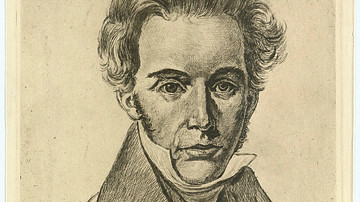
Søren Kierkegaard
Søren Kierkegaard (1813-1855) was a Danish philosopher and is considered to be the first existentialist, influencing such notable philosophers as Jean-Paul Sartre (1905-1980) and Martin Heidegger (1889-1976). His works are a...

Definition
Sushruta
Sushruta (c. 7th or 6th century BCE) was a physician in ancient India known today as the “Father of Indian Medicine” and “Father of Plastic Surgery” for inventing and developing surgical procedures. His work on the subject, the Sushruta...

Definition
Chichen Itza
Chichen Itza, located at the northern tip of the Yucatán Peninsula of modern Mexico, was a Maya city which was later significantly influenced by the Toltec civilization. Flourishing between c. 750 and 1200 CE, the site is rich in...

Definition
Nok Culture
The Nok culture, named after the settlement of the same name, flourished in southern West Africa (modern Nigeria) during the Iron Age from the 5th century BCE to the 2nd century CE. Famous for the distinctive terracotta sculptures...
