
Search
Remove Ads
Advertisement
Search Results

Image
Hittite Sphinx
This basalt Hittite sphinx was placed at the entrance into the palace number three at Sam'al (modern-day Sinjerli, Gaziantep, Turkey). Late Hittite period, 8th century BCE. (Istanbul Archaeological Museums/Ancient Orient Museum...

Definition
Hayasa-Azzi
The Hayasa-Azzi were an indigenous Bronze Age tribal confederation which flourished on the plateau of ancient Armenia and eastern Anatolia between c. 1500 and c. 1200 BCE. Although the historical record is impoverished and disputed...

Definition
Lycia
Lycia is a mountainous region in south-west Anatolia (also known as Asia Minor, modern-day Turkey). The earliest references to Lycia can be traced through Hittite texts to sometime before 1200 BCE, where it is known as the Lukka Lands...
Definition
Zarathustra
Zarathustra (also given as Zoroaster, Zartosht, Zarathustra Spitama, l. c. 1500-1000 BCE) was the Persian priest-turned-prophet who founded the religion of Zoroastrianism (also given as Mazdayasna “devotion to Mazda”), the first monotheistic...

Image
Winged Hittite Griffin-Demons
Relief orthostat (stone slab at the base of a wall) depicting two winged griffin demons, depicted as bird-headed with a human body. From Carchemish, Turkey. Dated to the Late Hittite period, 9-7th century BCE. Museum...
Image
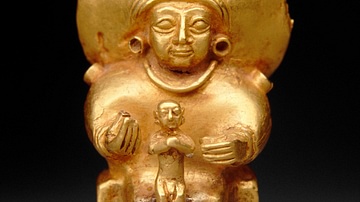
Seated Hittite Goddess with Child
Seated Hittite Goddess with Child, c. 14th-13th century BCE, from Central Anatolia, Metropolitan Museum of Art, New York.
Image
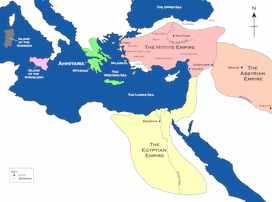
Map of the Hittite Empire and Surrounding States
A map of the Hittite Empire and surrounding states, including the Assyrian Empire, the Egyptian Empire, and Ahhiyawa. This map is an extract from the book Empires of Bronze by Gordon Doherty, republished...
Image
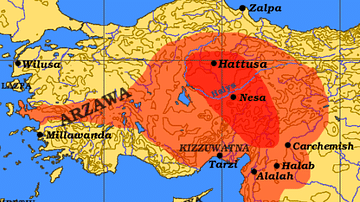
Hittite Empire c. 1300 BCE
The Hittite Empire at its maximum extension c. 1300 BCE (indicated in red. The Eyptian area of influence is indicated in green).

Image
Map of the Hittite Empire
A map showing the Hittite Empire in c. 1350-1300 BCE (dark green line) and at its maximum extent (light green area).

Image
The Sphinx Gate, Alacahöyük (Hittite settlement)
The Sphinx Gate at Alacahöyük (the site of a Neolithic and Hittite settlement in central Turkey) was built in the 14th century BCE. It was the south entrance of the city and was fortified with towers...
