
Search
Remove Ads
Advertisement
Search Results

Image Gallery
A Gallery of Mesopotamian Religion
Mesopotamian religion was informed by the belief that humans were co-workers with the gods in maintaining the order created at the beginning of time and so religious expression was integral to daily life in ancient...
Image
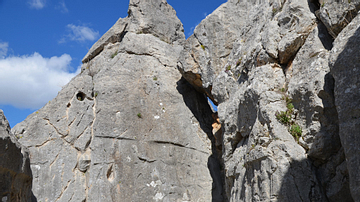
Hittite Rock Reliefs at Yazilikaya
Hittite rock reliefs in Chamber A of the Yazilikaya Hittite Sanctuary (13th century BCE). On the left wall, the relief depicts the meeting between Teshub, the Hurrian god of sky and storm, and Hepat, the mother...

Image
Yazilikaya Hittite Rock Sanctuary, Overview of Chamber A
The Yazilikaya Hittite sanctuary was made of two rock chambers, later labelled Chamber A and Chamber B by archaeologists. The walls of each chamber were covered with the richest and most striking...
Image
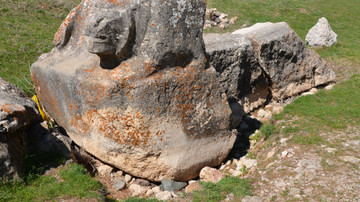
Hittite Lion Tub at Hattusa
A Hittite Lion Tub lying among the ruins of the Great Temple at Hattusa, the capital of the Hittite Empire. The basin was originally 5.5 metres long, and featured crouching lions at all four corners. It probably had a...
Image
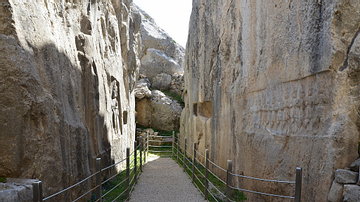
Yazilikaya Hittite Rock Sanctuary, Overview of Chamber B
The Yazilikaya Hittite sanctuary near Hattusa was made of two rock chambers, later labelled Chamber A and Chamber B by archaeologists. The walls of each chamber were covered with the richest and...
Image
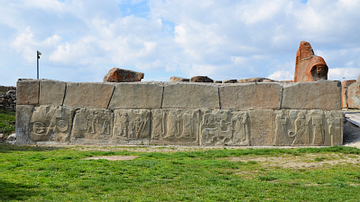
Hittite Orthostates at Alacahöyük
Copies of Hittite orthostates at Alacahöyük (the site of a Neolithic and Hittite settlement in central Turkey) which decorated the external facade of the Sphinx Gate, the south entrance to the city. They depict a...

Image
Treaty Establishing Hittite Domination over Aleppo
This clay tablet is known as the "Aleppo Treaty". The treaty was drawn up between the Hittite king Mursili II and Talmi-sharruma (king of Aleppo). It was written in Akkadian, the diplomatic language...

Image
Hittite Basalt Stela Showing Goddess Kubaba
The upper part is a freestanding basalt monument depicting the goddess Kubaba, consort of the storm god Teshub, and one of the most important deities at Carchemish. She holds a mirror and pomegranate, symbols...

Collection
Maya Religion & Culture
Maya religion and culture is among the most advanced and sophisticated of the Pre-Colombian Americas as evidenced by the ruins of their great cities and what remains of their writings after most were burned by the Spanish...

Collection
Ancient Egypt: Government & Religion
Government and religion in ancient Egypt were fully integrated beginning with the First Dynasty of Egypt (c. 3150 to c. 2890 BCE). The king was understood as a representative of a god, the specific deity sometimes...
