
Search
Remove Ads
Advertisement
Search Results

Article
Elephants in Hellenistic History & Art
Elephants were thought of as fierce and frightful monsters in antiquity, very real though rarely seen until the Hellenistic period. They were deployed on the battlefield to strike terror into the enemy, however...
Article
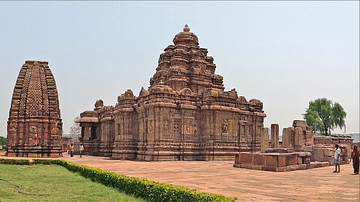
The Temples of Pattadakal
The history of Pattadakal goes back to a time when it was called Kisuvolal, a valley of red soil. It even found a mention in Ptolemy's Geography in the 2nd century CE. Presently Pattadakal is located in the district of...

Image
Kushite Archers
An artist's impression of the Kushite army - to which the archers in the foreground belong - in battle. The kingdom of Kush, situated in northern Africa, flourished between c. 1069 BCE and 350 CE. (From the PC game Total War...

Article
Roman Expeditions in Sub-Saharan Africa
Sub-Saharan Africa was explored by Roman expeditions between 19 BCE - 90 CE, most likely in an effort to locate the sources of valuable trade goods and establish routes to bring them to the seaports on the coast...

Definition
Jainism
Jainism is one of the oldest religions in the world. The name comes from jiva (soul or life force but, capitalized, is also given as Spiritual Conqueror) as it maintains that all living things possess an immortal soul which has always...

Definition
Sepoy Mutiny
The 1857-8 Sepoy Mutiny (aka Sepoy Rebellion, Indian Mutiny, The Uprising or First Indian War of Independence) was a failed rebellion against the rule of the British East India Company (EIC) in India. Initially a mutiny of the Indian...

Definition
Anahita
Anahita is the ancient Persian goddess of fertility, water, health and healing, and wisdom. Owing to her association with life-giving properties, she also came to be connected with ancient Persian warfare as soldiers would pray to her...

Definition
Indra - The Vedic Religion's Greatest God
The anthropomorphic god Indra was the most important god in the Vedic religion and he later became a major figure in Hinduism and an important deity in Buddhism, Cham and Chinese tradition. For the Aryas he...

Definition
White Huns (Hephthalites)
The White Huns were a race of largely nomadic peoples who were a part of the Hunnic tribes of Central Asia. They ruled over an expansive area stretching from the Central Asian lands all the way to the Western Indian Subcontinent...

Definition
Seven Lucky Gods
In Japanese folklore the Shichifukujin are the Seven Lucky Gods who may also be known as the Seven Gods of Happiness or the Seven Gods of Good Fortune. The seven gods are in fact of diverse origin as some are originally from Buddhism...
