
Search
Did you mean: Inca Art?
Remove Ads
Advertisement
Search Results

Definition
Ancient India
India is a country in South Asia whose name comes from the Indus River. The name 'Bharata' is used as a designation for the country in their constitution referencing the ancient mythological emperor, Bharata, whose story is told...

Definition
Mandala
A mandala (Sanskrit for “circle”) is an artistic representation of higher thought and deeper meaning given as a geometric symbol used in spiritual, emotional, or psychological work to focus one's attention. The image first appears in...

Definition
Surya
Surya (also known as Aditya) is the Hindu god of the Sun. He is considered the creator of the universe and the source of all life. He is the supreme soul who brings light and warmth to the world. Each day he travels across the sky in...

Definition
Hinduism
Hinduism is the oldest religion in the world, originating in Central Asia and the Indus Valley, still practiced in the present day. The term Hinduism is what is known as an exonym (a name given by others to a people, place, or concept...

Definition
Ravana
Ravana is the mythical multi-headed demon-king of Lanka in Hindu mythology. With ten heads and twenty arms, Ravana could change into any form he wished. Representing the very essence of evil, he famously fought and ultimately lost a series...

Definition
Krishna
Krishna (Krsna or Hari Krishna) is a major god of the Hindu pantheon and considered the eighth incarnation of Vishnu. He is perhaps the most popular of all the heroes of Hindu mythology. Krishna's adventures appear in the Mahabharata...

Interview
Interview: Pre-Raphaelites: Modern Renaissance
Pre-Raphaelites: Modern Renaissance marks the first multidisciplinary exhibition in Italy to examine the profound impact of Italian Renaissance art on the Pre-Raphaelite movement, which flourished in Victorian...
Definition
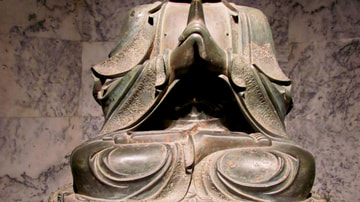
Esoteric Buddhism
Esoteric Buddhism is the mystical interpretation and practice of the belief system founded by the Buddha (known as Sakyamuni Buddha, l. c. 563 - c. 483 BCE). It is known by several names and is characterized by a personal relationship...

Definition
Vardhamana
Vardhamana (l. c. 599-527 BCE), better known as Mahavira (“Great Hero”) is the sage credited with founding of the nontheistic religion of Jainism, a belief system established in the 6th and 5th centuries BCE in India, which provided...
Article
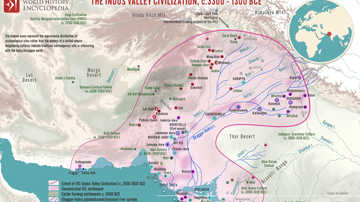
Religious Developments in Ancient India
For well over 1,000 years, sacred stories and heroic epics have made up the mythology of Hinduism. Nothing in these complex yet colourful legends is fixed and firm. Pulsing with creation, destruction, love...
