
Search
Did you mean: Hera?
Remove Ads
Advertisement
Search Results

Definition
Octavia Minor - The Sister of Augustus Who Helped Birth the Roman Empire
Octavia Minor (circa 69 BCE to 11 BCE) was a Roman noblewoman who rose to prominence during the early years of the Roman Empire. The sister of Emperor Augustus (reign 27 BCE to 14 CE...

Definition
Frederick the Great - Forging the Prussian State
Frederick II of Prussia (1712-1786), better known as Frederick the Great, was one of the most consequential rulers of 18th-century Europe. A scion of the House of Hohenzollern, he came to power in 1740...

Definition
Nebuchadnezzar II
Nebuchadnezzar II (r. 605/604-562 BCE) was the greatest King of ancient Babylon during the period of the Neo-Babylonian Empire (626-539 BCE), succeeding its founder, his father, Nabopolassar (r. 626-605 BCE). He is best known...

Definition
Gaius Marius
Gaius Marius (c. 157-86 BCE) was an accomplished military commander and politician who was acclaimed for saving Rome from the brink of collapse. Yet, unfortunately, his name has only survived in relative obscurity because his achievements...

Definition
Athena
Athena was the goddess of wisdom, war, and the crafts. She was the favourite daughter of Zeus and was, perhaps, the wisest, most courageous, and certainly the most resourceful of the Olympian gods. Zeus was told that his son would take...
Definition
Uat-Ur
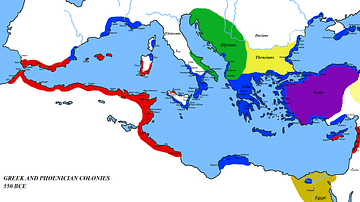
Uat-Ur was the ancient Egyptian name for the Mediterranean Sea (also known as Wadj-Wer) and is translated as 'the Great Green'. Uat-Ur was understood as a living entity imbued with the spirit of the divine which, like all other aspects...

Definition
Baal
Baal (also given as Ba'al) is a Canaanite-Phoenician god of fertility and weather, specifically rainstorms. The name was also used as a title, however, meaning "Lord" and was applied to a number of different deities throughout the ancient...

Definition
Brundisium
Brundisium (modern Brindisi), located on the Adriatic coast of southern Italy, was a Messapian and then Roman town of great strategic importance throughout antiquity. Although architectural remains are sparse, the city has several...

Definition
Amber in Antiquity
Amber, the fossilised resin of trees, was used throughout the ancient world for jewellery and decorative objects. The main source was the Baltic region where amber, known to mineralogists as succinite, was washed up onto beaches...

Definition
Ragnarök - The Cataclysmic Battle of Norse Mythology
Ragnarök is the cataclysmic battle between the forces of chaos and those of order in Norse mythology, ending the world and killing most of the gods and their adversaries, leading to the birth of a new...
