
Search
Remove Ads
Advertisement
Search Results

Video
Christianity from Judaism to Constantine: Crash Course World History #11
In which John Green teaches you the history of Christianity, from the beginnings of Judaism and the development of monotheism, right up to Paul and how Christianity stormed the Roman...

Image
Knight from the Hellenistic Period
This is a fragment of a terracotta plaque, which depicts a knight riding a horse. He holds a sword with his right arm. From Mesopotamia, Iraq. The Hellenistic period, 334-139 BCE. (The Sulaymaniayh Museum, Iraq)
Image
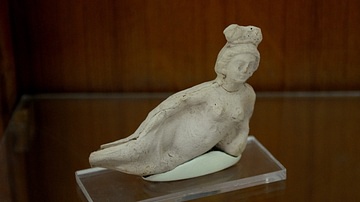
Woman from the Hellenistic Period
This terracotta statuette depicts a woman. The woman is recumbent and is naked and wears an elaborate headdress. She looks forward, as if she is talking to someone or looking at something. From Mesopotamia, Iraq...
Image
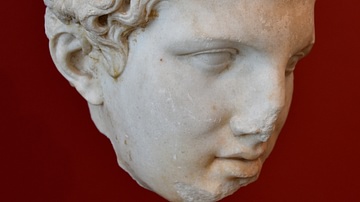
Portrait of a Hellenistic Ruler
This partly preserved head of a young man with idealized facial features is understood to represent a Hellenistic ruler, due to the band in his curly hair. Certain classification is however not possible. Historically...
Image
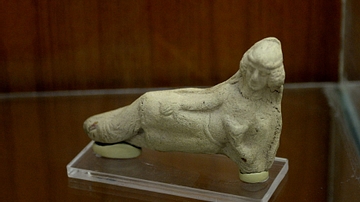
Hellenistic Woman
This terracotta statuette depicts a woman. The woman is recumbent but she is not naked. She looks forward, as if she is talking to someone or looking at something. She put her right arm on her right thigh but she holds something...

Image
Hellenistic Prince, Brundisium
A bronze figure known as the Hellenistic Prince, Brundisium, southern Italy, 2nd-1st century BCE. (Archaeological Museum of Brindisi, Italy)
Image
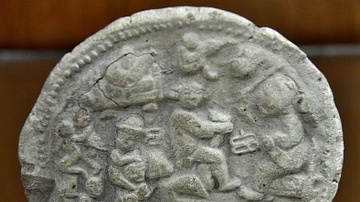
Pottery Plaque from the Hellenistic Period
This round pottery plaque depicts various human daily activities. In the middle, a man and a woman are having sex, and on the left, a standing woman holds a young child on her shoulders. Hellenistic Period...
Image
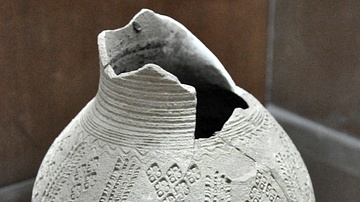
Pottery Jar from Hellenistic period
This partially broken jar dates back to the Hellenistic period, 323-30 BCE. From Mesopotamia, Iraq. (The Sulaimaniya Museum, Iraq).
Image
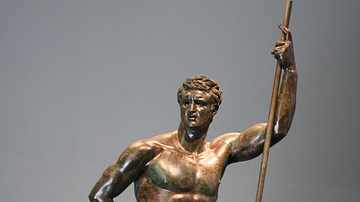
The Hellenistic Prince
The 2nd century BCE bronze statue known as 'The Hellenistic Prince'. The statue perhaps represents Attalus II, king of Pergamon. The head may also be a portrait of an unknown wealthy Roman, eager to appear as a Hellenistic...

Article
Hellenistic & Roman Agora of Athens
Pericles’ agora of Athens flourished under Macedonian control. After Macedon was defeated by Rome, the Romans added to the district even before Greece was taken as a province and more so afterwards. The Roman version...
