
Search
Remove Ads
Advertisement
Search Results

Article
Old Testament Pseudepigrapha
The Old Testament Pseudepigrapha are the non-canonical writings of Judaism and Christianity, ranging from the 5th century BCE to the 9th century CE. Pseudepigrapha comes from a Greek noun denoting writings with a false...
Image
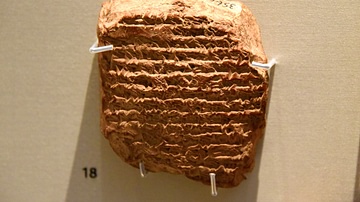
Tablet with Hellenistic King List
Written in Babylonian in the cuneiform inscription, this tablet lists the names and dates of several Seleucid kings. After Alexander's death, the Persian Empire fractured. Mesopotamia and Syria became part of the...

Article
Christian Antisemitism in the Middle Ages & during the Reformation
Antisemitism is a modern term that describes prejudice and hostility to Jews and Judaism. The origins of Christian antisemitism in the gospels are based on the story of a 1st-century itinerant...

Article
Passover in the Hebrew Bible
Passover is a Jewish festival celebrated since at least the 5th century BCE, typically associated with the tradition of Moses leading the Israelites out of Egypt. According to historical evidence and modern-day practice...

Definition
New Testament
New Testament is the name for the second half of the Christian Bible, compiled from the 2nd century CE, after the separation of Christianity from Judaism. The Christian Bible retained books of the Jewish scriptures, the Old Testament...

Definition
Ten Commandments
The Ten Commandments introduce the legislation received by Moses on Mt. Sinai after the Israelites escaped from Egypt (as related in the biblical book of Exodus). The "ten commandments" is often used as shorthand for the basic...

Article
LGBTQ in Early Christianity
In modern debates concerning homosexuality, same-sex marriages, and gender identification, it is popular to turn to the Bible for passages to validate a position. Modern culture attributes many elements in understanding...

Video
The Church and The Jews - The Hellenistic Period
In this sixth segment of Dr. David Neiman's lecture series, "The Church and The Jews", Dr. Neiman follows the conquests of Alexander the Great and the subsequent spread of the Jewish diaspora through...

Image
Hellenistic Trade Routes, 300 BCE
Alexander the Great died in Babylon on the 13th of June, 323 BCE. His Macedonian-Greek empire broke apart, but Alexander’s heritage was felt throughout the ancient Mediterranean world for centuries. Three Hellenic...

Article
The Ideal of Christendom in Antiquity
The ideal of Christendom is a historical and political vision where society and government are unified under the Christian faith. According to this vision, power on Earth is divided between the church through...
