
Search
Remove Ads
Advertisement
Search Results

Article
The Parthenon Sculptures
The extraordinary quality and quantity of the marble sculpture which adorned the 5th century BCE Parthenon in Athens made it the most richly decorated of all Greek temples. The sculpture, now mostly separated into the Parthenon...
Definition
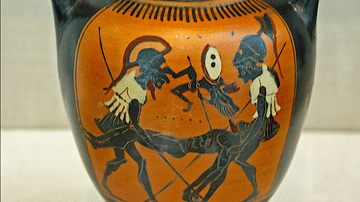
Thanatos
Thanatos is the personification of Death in Greek mythology. He is the son of Nyx (Night) and the twin brother of Hypnos (Sleep). Some sources also name Erebus (Darkness) as his father. As the personification of Death, Thanatos works...

Definition
Themistocles
Themistocles (c. 524 - c. 460 BCE) was an Athenian statesman and general (strategos) whose emphasis on naval power and military skills were instrumental during the Persian wars, victory in which ensured that Greece survived its greatest...

Definition
Ancient Greek Music
Music (or mousike) was an integral part of life in the ancient Greek world, and the term covered not only music but also dance, lyrics, and the performance of poetry. A wide range of instruments was used to perform music which...

Definition
Athenian Democracy
Athenian democracy refers to the system of democratic government used in Athens, Greece from the 5th to 4th century BCE. Under this system, all male citizens - the dēmos - had equal political rights, freedom of speech, and the...

Definition
William Barret Travis - The Unlikely Hero of the Alamo
William Barret Travis (1809 to 1836) is best known as the commander of the Alamo during the 13-day siege (23 February to 6 March 1836), dying in the Battle of the Alamo on 6 March at the age of 26...

Definition
Ionia
Ionia was a territory in western Anatolia (modern-day Turkey) populated by the Ionians (Greeks who spoke the Ionian dialect) in c. 1150 BCE. It is best known as the birthplace of Greek philosophy (at Miletus) and the site of the Ionian...
Definition
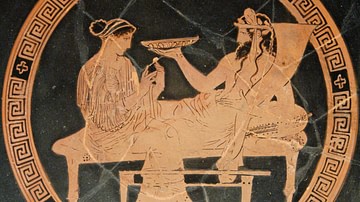
Persephone
Persephone (aka Kore) was the Greek goddess of agriculture and vegetation, especially grain, and the wife of Hades, the ruler of the Underworld. Persephone was an important element of the Eleusinian Mysteries and the Thesmophoria...

Definition
Hippolytus
Hippolytus is a tragedy written by Euripides (c. 484-407 BCE), one of the great Greek playwrights of the early 5th century BCE. As with many tragedies of the era, the central focus of Hippolytus is humanity's relationship with the...

Definition
Ptolemy II Philadelphus
Ptolemy II Philadelphus ("The Sibling Loving", r. 282-246 BCE) was the second ruler of the Ptolemaic Dynasty. He consolidated the kingdom conquered by his father Ptolemy I and presided over its golden age. Ptolemy II invested...
