
Search
Remove Ads
Advertisement
Search Results

Definition
Scythian Art
Scythian art is best known for its 'animal art.' Flourishing between the 7th and 3rd centuries BCE on the steppe of Central Asia, with echoes of Celtic influence, the Scythians were known for their works in gold. Moreover, with the...

Definition
Samos
Samos is a Greek island in the east Aegean, just off the coast of modern-day Turkey. It particularly flourished in the 6th century BCE and was famous in antiquity for its navy, wine, and important sanctuary to Hera. Samos was an active...

Definition
Stupa
A stupa (literally “heap” or “pile”) is a reliquary, a shrine containing the remains of a holy or sainted person and/or artifacts (relics) associated with them, originating in India prior to the 5th century BCE as tombs of holy men and...

Definition
Cerveteri
Cerveteri (Etruscan name: Cisra or Caisra, Greek: Agylla, Roman: Caere) was an important Etruscan town which flourished between the 7th and 4th century BCE. Located near the western coast of central Italy, around 50 km north of Rome...

Definition
Ancient Greek Pottery
Greek pottery has four main types: Geometric, Corinthian, Athenian Black-figure, and Athenian red-figure pottery. Pottery vessels were made for everyday use such as the two-handled amphora for storage, the single-stem kylix...

Definition
Charon - The Ferryman to the Dead in Greek Mythology
Charon is a figure from Greek mythology where he is the boatman who ferries the souls of the dead across the waters of Hades to the judgement which will determine their final resting place. The Greeks...

Definition
Moche Civilization
The Moche civilization (also known as the Mochica) flourished along the northern coast and valleys of ancient Peru, in particular, in the Chicama and Trujillo Valleys, between 1 CE and 800 CE. The Moche state spread to eventually...
Definition
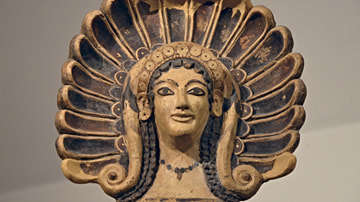
Veii
Veii (modern name: Isola Farnese, in Etruscan: Vei), was an important Etruscan town located near the west coast of central Italy. Lying just 16 km north of Rome, it was the most southerly of the major Etrurian settlements. The prosperity...
Definition
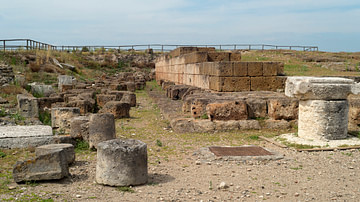
Vulci
Vulci (Velch) was an Etruscan city located 12 km from the western coast of central Italy by the banks of the Fiora River. Flourishing as a trading port between the 6th and 4th century BCE, it was an important member of the Etruscan League...

Definition
Viking Art
Art made by Scandinavians during the Viking Age (c. 790-1100 CE) mostly encompassed the decoration of functional objects made of wood, metal, stone, textile and other materials with relief carvings, engravings of animal shapes and...
