
Search
Remove Ads
Advertisement
Search Results

Definition
Imhotep
Imhotep (Greek name, Imouthes, c. 2667-2600 BCE) was an Egyptian polymath (a person expert in many areas of learning) best known as the architect of King Djoser's Step Pyramid at Saqqara. His name means "He Who Comes in Peace" and he...

Definition
Ptolemy of Mauretania
Ptolemy of Mauretania (r. 23-40 CE) was king of Mauretania and one of the last surviving members of the Ptolemaic dynasty. His father Juba II (c. 48 BCE to 23 CE) was a Numidian royal and his mother Cleopatra Selene II (40...

Definition
Ptolemy I
Ptolemy I Soter (366-282 BCE) was one of the successor kings to the empire of Alexander the Great. He served not only as king of Egypt but also the founder of the Ptolemaic Dynasty, a dynasty which included the infamous Cleopatra VII...

Definition
Ptolemy XII
Ptolemy XII Neos Dionysos (r. 80-51 BCE) was king of Ptolemaic Egypt and father of Cleopatra VII (r. 51-30 BCE). His illegitimate birth and drunkenness inspired ridicule, and he was nicknamed "Auletes" ("the Flute-Player") for his...

Definition
Bai Juyi
Bai Juyi (l. 772-846) was one of the greatest poets of the Tang Dynasty (618-907) along with Li Po (l. 701-762) and Du Fu (l. 712-770). He was a government official who got in trouble with authorities a number of times for not following...

Definition
Ancient Korean Coinage
The coinage of ancient Korea (pre-13th century CE) first employed Chinese coins, known locally as the oshuchon. Korean rulers began minting their own metal coins from the late 10th century CE, first in copper and iron, and...

Definition
Taejo of Goryeo
Taejo (r. 918-943 CE), previously known as Wang Geon or Wang Kon, was the founder and first king of the Goryeo (Koryo) kingdom which unified and ruled ancient Korea from 918 CE to 1392 CE. Wang Geon was given the posthumous title...

Definition
Pax Mongolica - Trade and Cultural Exchange in the Mongol Empire
The Mongol Empire was the largest land empire in world history, at about 22,000,000 square kilometers (850,000 square miles). The term Pax Mongolica (Mongol Peace) refers to the way this massive...

Definition
Charlemagne
Charlemagne (Charles the Great, also known as Charles I, l. 742-814) was King of the Franks (r. 768-814), King of the Franks and Lombards (r. 774-814), and Holy Roman Emperor (r. 800-814). He is among the best-known and most influential...
Definition
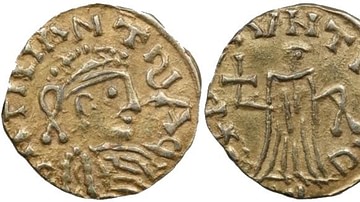
Guntram I of Orléans
Guntram I (also given as Gontrand, Gunthram, or Gunthchramn) was a Merovingian king who ruled over the Frankish kingdom of Orléans, later referred to as Burgundy, from 561 to 592. He often took on the role of mediator in the...
