
Search
Remove Ads
Advertisement
Search Results

Image
Greek Slave Handcuffs
Bronze slave handcuffs from the Greek colony of Heraclea in southern Italy. 4th-2nd century BCE. (Archaeological Museum, Policoro, Italy)

Image
Head of a Greek Youth
This is the head of a statue of a Greek youth or Kouros. The rest of the body is in the Samos Museum; the whole statue would measure about 3.2 meters in height. His hair is plaited and falls behind the head, down to the neck...

Definition
Oedipus the King
Oedipus the King (429-420 BCE), also known as Oedipus Rex or Oedipus Tyrannos ('Tyrannos' signifies that the throne was not gained through an inheritance) is the most famous surviving play written by the 5th-century BCE poet and...

Definition
Scientific Method
The scientific method was first used during the Scientific Revolution (1500-1700). The method combined theoretical knowledge such as mathematics with practical experimentation using scientific instruments, results analysis and...
Image
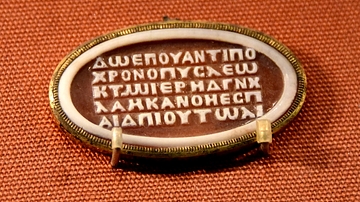
Sardonyx Cameo Showing Nonsense Greek Inscription
Skillful Roman cameo-carvers exploited the tonal contrast of some stones. This could be a simple two-tone contrast or a more subtle variation using all available gradations of shade. Sardonyx was particularly...

Image
Greek Ceramic Toys
Artefacts of the ancient city of Amphipolis displayed in the Museum. Children's toys.
Location: Amphipolis, Macedonia, Greece. 1st Century BCE - 1 Century CE

Image
Greek Lead Weights
Standard lead weights from the agora of Athens. 5th-2nd century BCE. (Agora Museum, Athens)
Image
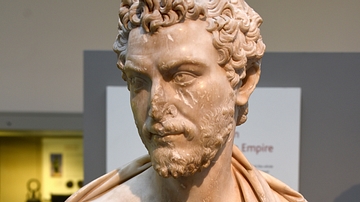
Marble Bust of a Young Greek Male
The man is dressed like Greeks of the Classical Period. His chest is bare and he has a heavy mantle draped over his shoulders This does not reflect the real fashion of his time, but is meant to lend him an air of...

Image
Greek Glass Amphoriskos from Amman
An amphoriskos is a small amphora, typically less than 4 inches in height. Polychrome and sand-core formed. The decoration and the technique used are very similar to Phoenician glass, reflecting the trade and cultural...

Image
Eschara (Greek Brazier)
A shallow brazier (eschara) in terracotta with metal spits. 6th-4th century BCE. (Agora Museum, Athens)
