
Search
Remove Ads
Advertisement
Search Results

Video
Telesilla of Argos, the Greek Lyric Poet who Defended Argos
Telesilla was a Greek lyric poet who lived in Argos in the fifth century BCE. Along with the famous poet Sappho, Telesilla was named as one of the Nine Female Lyric Poets of Greece, and is known...

Image
Celtic Coin from Thrace Copying Greek Inscription
Early Iron Age Celtic people copied Greek coins, often faithfully reproducing their designs and inscriptions. This suggests that Thracian die-engravers were illiterate, as legible Greek letters were...
Image
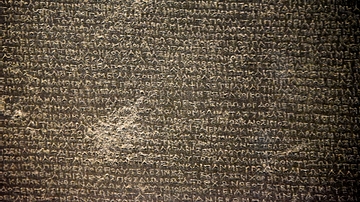
Rosetta Stone Detail, Greek Text
This is a zoomed-in detail of the lower part of the Rosetta stone showing the Greek text. The Rosetta Stone is a large almost complete fragment of a grey-pink granodiorite stela. A decree was carved on this stela...

Definition
Oedipus the King
Oedipus the King (429-420 BCE), also known as Oedipus Rex or Oedipus Tyrannos ('Tyrannos' signifies that the throne was not gained through an inheritance) is the most famous surviving play written by the 5th-century BCE poet and...
Image
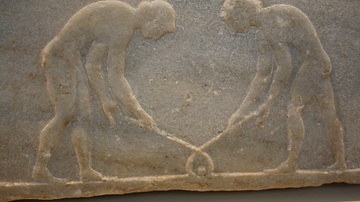
Greek Hockey Players
Greek athletes playing a game similar to modern hockey. From the base of a funerary kouros, later included in the Themistokleian Wall of Athens. 510-500 BCE. (National Archaeological Museum, Athens)

Image
Greek Articulated Doll
An articulated terracotta doll and figure representing a baker from a child's tomb at Greek Empuries (Emporiae), Spain. 5th-4th century BCE. (Archaeological Museum, Empuries)
Image
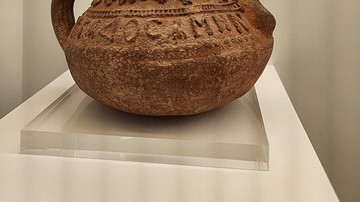
Oil Lamp with Running Animals & Greek Inscription
From a workshop in Upper Egypt.
The Greek inscription says "The Holy and Consubstantial Trinity Amen."
4th-5th century CE. Made from clay. (Hellenic Museum, Melbourne, Victoria).

Image
Greek Athletes
Greek athletes. From the base of a funerary kouros, later included in the Themistokleian Wall of Athens. 510-500 BCE. (National Archaeological Museum, Athens)

Image
Relief of a Greek Warrior
This relief of a Greek warrior dates from 600-50 BCE. It is made from marble. (Iris & B. Gerald Cantor Center for Visual Arts at Stanford University, Stanford, California)

Image
Greek Bronze Ballot Disks
Bronze ballot disks used in Greek courts to vote guilty (a hole in the centre) or innocent (a solid centre). c. 300 BCE. (Agora Museum, Athens)
