
Search
Remove Ads
Advertisement
Search Results

Definition
Miltiades
Miltiades (c. 555-489 BCE) was the Athenian general who defeated the Persians at the Battle of Marathon in 490 BCE. The Greeks faced a Persian force of superior numbers led by the commanding admiral Datis, who had been sent by their...

Definition
Carthaginian Art
The art of the Carthaginians was an eclectic mix of influences and styles, which included Egyptian motifs, Greek fashion, Phoenician gods, and Etruscan patterns. Precious metals, ivory, glass, terracotta, and stone were transformed...

Definition
Tyche
In Greek mythology, Tyche is the goddess and personification of good luck, chance, and fortune. Tyche's popularity grew after the Classical period when many cities and officials across the Greek world and the Mediterranean adopted her...

Article
Elizabeth I & the Power of Image
Aware of the power of appearances, Elizabeth I of England (r. 1558-1603 CE) carefully controlled her image throughout her reign and through costume, hair, jewellery, and art, she presented herself as the great Virgin...

Definition
Agamemnon (Play)
The play Agamemnon was written by one of the greatest Greek tragedians Aeschylus (c. 525 – 455 BCE), “Father of Greek Tragedy.” Older than both Sophocles and Euripides, he was the most popular and influential of all tragedians...

Definition
Theogony
The Theogony is an 8th-century BCE didactic and instructional poem, credited to the Greek poet Hesiod. The Theogony was, at first, not actually written down, rather, it was part of a rich oral tradition which only achieved written form...

Definition
Philosophy
The word philosophy comes from the Greek philo (love) and sophia (wisdom) and so is literally defined as “the love of wisdom”. More broadly understood, it is the study of the most basic and profound matters of human existence. Philosophical...
Definition
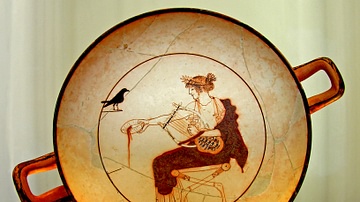
Lyre
The lyre was a stringed musical instrument played by the ancient Greeks. It was probably the most important and well-known instrument in the Greek world. The lyre was closely related to the other stringed instruments: the chelys which...

Definition
Magna Graecia
Magna Graecia (Megalē Hellas) refers to the coastal areas of southern Italy which were colonized by various ancient Greek city-states from the 8th to 5th centuries BCE. Sicily, although also a region of Greek colonization, is not...

Definition
Mystras
The city of Mystras (or Mistras) in southern Greece was the provincial capital of the Byzantine Despotate of the Morea from the 13th through the 15th centuries CE. It was founded in 1249 CE by William II of Villehardouin, and it served...
