
Search
Did you mean: Greek Fire?
Remove Ads
Advertisement
Search Results
Image
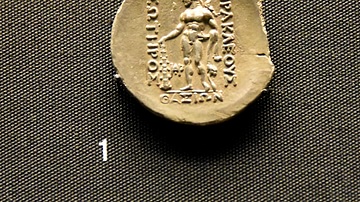
Celtic Coin Copying Greek Inscription
Early Iron Age Celtic people copied Greek coins, often faithfully reproducing their designs and inscriptions. This suggests that Thracian die-engravers were illiterate, as legible Greek letters were gradually...

Video
The Greek Hero Bellerophon and his Flying Horse Pegasus
Bellerophon or Bellerophontes is a hero in Greek mythology who is best known as the man who tamed the winged horse Pegasus. Bellerophon was the son of Poseidon the god of the sea and horses and...
Image
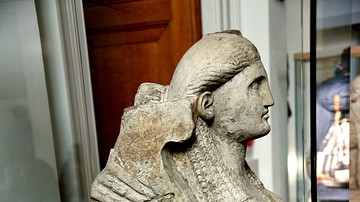
Greek Sphinx, British Museum
Greek sphinx that may once have guarded the tomb of a Greek inhabitant in Egypt. Roman Egypt, 2nd century CE. In Greek mythology, the sphinx was a monster with the head of a woman, a bird's wings, the body of a lion...

Definition
Sarpedon
Sarpedon is a figure from ancient Greek mythology, a Lycian prince who was one of the principal heroes during the Trojan War and fought on the side of Troy. According to Homer's Iliad, he was the son of Zeus by Laodameia and the cousin...

Video
Telesilla of Argos, the Greek Lyric Poet who Defended Argos
Telesilla was a Greek lyric poet who lived in Argos in the fifth century BCE. Along with the famous poet Sappho, Telesilla was named as one of the Nine Female Lyric Poets of Greece, and is known...

Definition
Iphigenia in Aulis
Iphigenia in Aulis (or at Aulis) was written by Euripides, the youngest and most popular of the trilogy of great Greek tragedians. The play was based on the well-known myth surrounding the sacrifice of Agamemnon and Clytemnestra's...

Definition
Antikythera Mechanism
The Antikythera mechanism (also known as the Antikythera Device), dated to the late 2nd century/early 1st century BCE (roughly 205-60 BCE) is understood as the world's first analog computer, created to accurately calculate...
Image
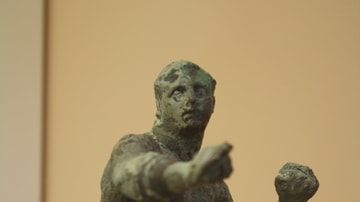
Greek Pankratiast
A bronze statue of a pankratiast (2nd century BCE). The leather thongs wrapped around the fist, worn by later exponents of this viiolent mix of wrestling and boixing, can be clearly seen. (Olympia Archaeological Museum, Olympia...
Image
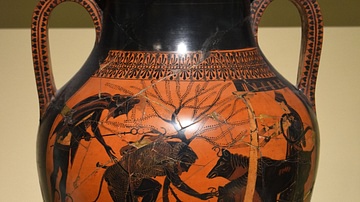
Black Figured Greek Amphora
This black figured amphora was made by the Andokides Painter of Attica, and it dates from c. 530 BCE. It is made of clay and special glaze. (Pushkin Museum, Moscow)
Image
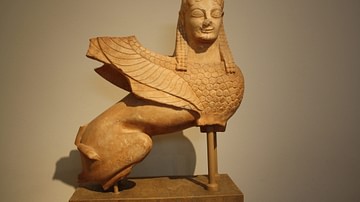
Greek Funerary Sphinx
A sphinx in pentelic marble, from a funerary stele, c. 570 BCE.
National Archaeological Museum, Athens.
