
Search
Did you mean: God?
Remove Ads
Advertisement
Search Results

Article
The Lamentations of Isis and Nephthys
The Lamentations of Isis and Nephthys is an ancient Egyptian text in which the two goddess-sisters call the soul of the god Osiris to rejoin the living. The poem takes the form of a call-and-response liturgy and...

Article
Medicine in Ancient Mesopotamia - A Gift of the Gods to Their People
In ancient Mesopotamia, the gods informed every aspect of daily life, including the practice of medicine. Gula, the Sumerian goddess of healing, presided over the medical arts, guiding...

Article
Shulgi and Ninlil's Barge - A Poem Celebrating a Divine Event
Shulgi and Ninlil's Barge is a Sumerian poem dated to the reign of Shulgi of Ur (2094 - circa 2046 BCE) celebrating the caulking of the barge of the goddess Ninlil, consort of the sky god Enlil...

Article
The Debate Between Sheep and Grain - A Sumerian Argument Between Animal Husbandry & Agriculture
The Debate Between Sheep and Grain (circa 2000 BCE) is one of the best-known Sumerian literary debates in a genre that was popular entertainment by the late 3rd millennium...

Definition
Esarhaddon
Esarhaddon (r. 681-669 BCE) was the third king of the Sargonid Dynasty of the Neo-Assyrian Empire. He was the youngest son of King Sennacherib (r. 705-681 BCE), and his mother was not the queen but a secondary wife, Zakutu (also known...

Definition
Tukulti-Ninurta I
Tukulti-Ninurta I (reigned 1244-1208 BCE) was a king of the Assyrian Empire during the period known as the Middle Empire. He was the son of Shalmaneser I (reigned 1274-1245 BCE) who had completed the work of his father, Adad...

Definition
Sargonid Dynasty
The Sargonid Dynasty was the last ruling house of the Neo-Assyrian Empire from 722-612 BCE, beginning with the reign of Sargon II and ending with fall of the Neo-Assyrian Empire. Some of the most famous kings in the history of...

Definition
Fates
The Fates (also known as the Moirai in Greek mythology) are three sister goddesses responsible for assigning destinies to mortals at their birth, a human's lifespan, and the timing of their death. The golden thread they spin represents...

Definition
Pharaoh
The Pharaoh in ancient Egypt was the political and religious leader of the people and held the titles 'Lord of the Two Lands' and 'High Priest of Every Temple'. The word 'pharaoh' is the Greek form of the Egyptian pero or per-a-a, which...
Definition
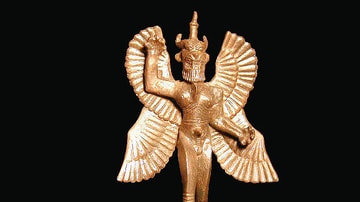
Pazuzu - The Mesopotamian Demon of Destruction and Protection
Pazuzu is a Babylonian/Assyrian demon who was most popular in the first millennium BCE. He was the son of Hanbi (also Hanba), king of the demons of the underworld, and brother of Humbaba, the...
