
Search
Did you mean: God?
Remove Ads
Advertisement
Search Results

Article
Daily Life in Ancient China
Daily life in ancient China changed through the centuries but reflected the values of the presence of gods and one's ancestors in almost every time period. Villages like Banpo show evidence of a matriarchal society, where...

Definition
Kami
In the Shinto religion kami is an all-embracing term which signifies gods, spirits, deified mortals, ancestors, natural phenomena, and supernatural powers. All of these kami can influence people's everyday lives and so they are worshipped...

Definition
Gutians - The Great Villains of the Sumerian Scribes
The Gutians were a West Asiatic people who are thought to have lived around the Zagros Mountains in a region referred to as Gutium. They had no written language and all that is known of them comes from...

Definition
Titan - The Gods Defeated by the Greek Olympians
In Greek mythology the terrible and powerful Titans were those deities which preceded the Olympian gods. Never worshipped as the other gods, they nevertheless helped, through contrast, to clarify the position...

Definition
Nephthys
Nephthys was one of the original five gods of ancient Egypt born of the union of Geb (earth) and Nut (sky) after the creation of the world. She was the fourth born after Osiris, Isis, and Set and was the older sister of Horus (usually...

Definition
Assyria
Assyria was the region located in the ancient Near East which, under the Neo-Assyrian Empire, reached from Mesopotamia (modern-day Iraq) through Asia Minor (modern Turkey) and down through Egypt. The empire began modestly at the city...
Definition
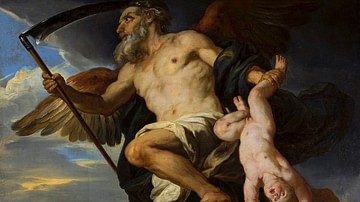
Cronus
In Greek mythology, Cronus (also spelt Kronos) is a Titan and the youngest son of Uranus (Heaven/Sky) and Gaia (Earth). He dethroned Uranus and became the world's first king, ruling over his siblings and fellow Titans. Cronus married...

Definition
Mesopotamian Naru Literature - The World's First Historical Fiction
Mesopotamian Naru Literature was a literary genre, first appearing around the 2nd millennium BCE, which featured a famous person (usually a king) from history as the main character in a...

Definition
The Negative Confession
The Negative Confession (also known as The Declaration of Innocence) is a list of 42 sins which the soul of the deceased can honestly say it has never committed when it stands in judgment in the afterlife. The soul would...

Definition
Ancient Egyptian Art
The artworks of ancient Egypt have fascinated people for thousands of years. The early Greek and later Roman artists were influenced by Egyptian techniques and their art would inspire those of other cultures up to the present...
