
Search
Remove Ads
Advertisement
Search Results
Definition
Britomartis
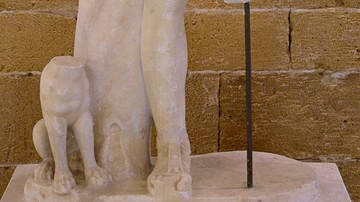
Britomartis, also known as Diktynna (Dictynna), was the Cretan goddess of hunting and fishing nets in Greek mythology. Although referred to as a nymph and worshipped locally, she had at least two significant and active shrines, one in Crete...

Article
Hesiod on the Birth of the Gods
The Greek poet Hesiod (c. 700 BCE) is most famous for his works Theogony and Works and Days. In this passage from Theogony, Hesiod relates the birth of the gods from cosmic Chaos and follows the lineage through the great Zeus, King of the...

Article
The Ancient Celtic Pantheon
The ancient Celtic pantheon consisted of over 400 gods and goddesses who represented everything from rivers to warfare. With perhaps the exception of Lugh, the Celtic gods were not universally worshipped across Iron Age Europe but were very...

Definition
Hathor
Hathor is an ancient Egyptian goddess associated, later, with Isis and, earlier, with Sekhmet but eventually was considered the primeval goddess from whom all others were derived. She is usually depicted as a woman with the head of a cow...

Definition
Nephthys
Nephthys was one of the original five gods of ancient Egypt born of the union of Geb (earth) and Nut (sky) after the creation of the world. She was the fourth born after Osiris, Isis, and Set and was the older sister of Horus (usually referred...

Definition
Ninhursag - The Original Mother Earth
Ninhursag (also Ninhursaga) is the Sumerian mother goddess and one of the oldest and most important in the Mesopotamian pantheon. She is known as the Mother of the Gods and Mother of Men for her part in creating both divine and mortal entities...

Definition
Apophis
Apophis (also known as Apep) is the Great Serpent, enemy of the sun god Ra, in ancient Egyptian religion. The sun was Ra's great barge which sailed through the sky from dawn to dusk and then descended into the underworld. As it sailed through...

Definition
Gaia
Gaia (also Gaea or Ge) is a primordial goddess and the personification of the Earth in Greek mythology. Gaia emerged from Chaos and is considered the supreme or mother goddess by immortals and mortals alike. All gods and goddesses are descended...

Definition
Tiamat - The Great Mesopotamian Goddess of Chaos
Tiamat is the Mesopotamian goddess associated with primordial chaos and the salt sea, best known from the Babylonian epic Enuma Elish. In all versions of the myth, following the original, Tiamat always symbolizes the forces of chaos, which...

Definition
Fates
The Fates (also known as the Moirai in Greek mythology) are three sister goddesses responsible for assigning destinies to mortals at their birth, a human's lifespan, and the timing of their death. The golden thread they spin represents each...
