
Search
Remove Ads
Advertisement
Search Results

Definition
Juno
Juno was the Roman goddess who protected the nation as a whole but also kept special watch over all aspects of women's lives. She is often thought of as the Roman version of the Greek goddess of love and marriage, Hera. Juno was the wife...
Definition
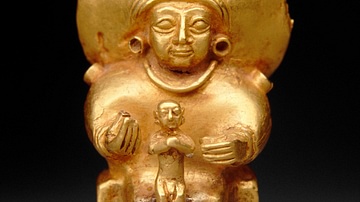
Sauska - The Hurrian's Radiant Goddess of Fertility and War
Sauska (also known as Shaushka, Sausga, and Anzili) was the Hurrian-Hittite goddess of fertility, war, and healing. She was worshipped throughout the region known as Hanigalbat (present day Iraq, Syria, and Turkey) from the time of the Hurrians...

Definition
The Graces
The Graces (also Charites, sing. Charis) were goddesses from Greek mythology who personified charm, grace, and beauty. Hesiod describes three Graces, and this is their most common grouping in literature and art, but their number varies depending...

Definition
Orosius - Great Defender of Christianity Against the Pagans
Paulus Orosius (usually given as Orosius, 5th century) was a Christian theologian and historian who was also a friend and protege of Saint Augustine of Hippo (354-430). He is best known for his work Seven Books of History Against the Pagans...

Article
Beauty in the Bronze Age - Minoan & Mycenaean Fashion
Dress and appearance in Bronze Age Greece (c. 3100 BCE - c. 1100 BCE) played a part in defining gender roles and emphasising idealized beauty that planted the seed for modern-day standards. The Minoans turned the island of Crete into a Mediterranean...

Article
Women in the Middle Ages
The lives of women in the Middle Ages were determined by the Church and the aristocracy. The medieval Church provided the 'big picture' of the meaning of life and one's place while the aristocracy ensured that everyone stayed in their respective...

Article
The Christian Concept of Human Sexuality as Sin
In the ancient world, human sexuality was crucial for the survival of the tribe and clan as well as pleasurable, a gift from the gods. Thousands of native cults emphasized fertility through rituals and prayers, and ancient gods were depicted...

Article
The Hymn to Ninkasi, Goddess of Beer - A Praise Song and Ancient Beer Recipe
The Hymn to Ninkasi is at once a song of praise to Ninkasi, the Sumerian goddess of beer, and an ancient recipe for brewing (though this claim has been challenged). Written down circa 1800 BCE, the hymn is no doubt much older, as evidenced...

Article
Egyptian Afterlife - The Field of Reeds
The ancient Egyptians believed that life on earth was only one part of an eternal journey which ended, not in death, but in everlasting joy. When one's body failed, the soul did not die with it but continued on toward an afterlife where one...

Article
Ancient Celtic Society
The society of the Celts in Iron Age Europe was made up of several distinct hierarchical groups. At the top were rulers and elite warriors, then there were the religious leaders, the druids, and then specialised craftworkers, traders, farmers...
