
Search
Remove Ads
Advertisement
Search Results

Definition
Idunn
Idunn (pronounced Ih-dune) is a fertility goddess in Norse mythology who holds the apples of eternal youth the gods rely on to remain young and healthy. The Norse gods were not immortal – they just lived very long lives – and the apples...

Definition
Council of Trent
The Council of Trent (1545-1563) was a meeting of Catholic clerics convened by Pope Paul III (served 1534-1549) in response to the Protestant Reformation. In three separate sessions, the council reaffirmed the authority of the...

Definition
Julius Caesar
Gaius Julius Caesar was born 12 July 100 BCE (though some cite 102 as his birth year). His father, also Gaius Julius Caesar, was a Praetor who governed the province of Asia and his mother, Aurelia Cotta, was of noble birth. Both...

Definition
Caligula - The First Mad Emperor of Rome
Caligula (12-41 CE) was the third Roman emperor, who reigned from 37 to 41 CE. A member of the Julio-Claudian Dynasty, he came to power after the death of his great-uncle Tiberius. The ancient sources claim...

Definition
Ancient Ireland
Ireland is an island country located in the North Atlantic, bounded by the North Channel, the Irish Sea, and St. George's Channel. It is known as Eire in the Gaelic language, which comes from the old Irish Eriu, the name of a...

Definition
Pliny the Elder
Aside from the usual contributions of its noble politicians and military commanders, the story of a nation also records the invaluable literary influences of its poets, dramatists, and historians. The long history of the Roman...
Definition
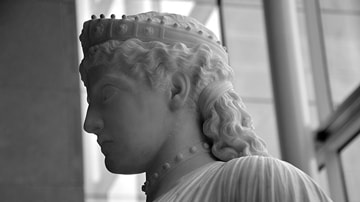
Semiramis
Semiramis is a legendary queen thought to based on the historical Sammu-Ramat (r. 811-806 BCE) the queen regent of the Assyrian Empire who held the throne for her young son Adad Nirari III until he reached maturity. She is also known...

Definition
Amber in Antiquity
Amber, the fossilised resin of trees, was used throughout the ancient world for jewellery and decorative objects. The main source was the Baltic region where amber, known to mineralogists as succinite, was washed up onto beaches...

Definition
Charlemagne
Charlemagne (Charles the Great, also known as Charles I, l. 742-814) was King of the Franks (r. 768-814), King of the Franks and Lombards (r. 774-814), and Holy Roman Emperor (r. 800-814). He is among the best-known and most influential...

Definition
Dagobert I
Dagobert I (l. 605-639) ruled as King of Austrasia from 623 to 634 and as King of All the Franks from 629 to 639. Together with the reign of his father, Chlothar II, the period of Dagobert's rule has been characterized as the peak...
