
Search
Did you mean: Fates?
Remove Ads
Advertisement
Search Results

Definition
Mehmed II
Mehmed II (1432-1481 CE), also known as Mehmed the Conqueror, was the seventh and among the greatest sultans of the Ottoman Empire. His conquests consolidated Ottoman rule in Anatolia and the Balkans, and he most famously triumphed...

Definition
Baba Yaga
Baba Yaga (Baba Jaga) is a witch or ogress from Slavic folklore who lives in a magical hut in the forest and either helps, imprisons, or eats people (usually children). She is among the most famous figures from Slavic folklore as guardian...

Definition
Iliad
Homer's Iliad describes the final year of the Trojan War, a legendary conflict between an alliance of Greek cities and the city of Troy in Anatolia. It was probably written in the 8th century BCE after a long oral tradition. The Greeks...

Definition
Ishtar
Ishtar (Inanna in Sumerian sources) is a primary Mesopotamian goddess closely associated with love and war. This powerful Mesopotamian goddess is the first known deity for which we have written evidence. While largely unknown in the modern...
Definition
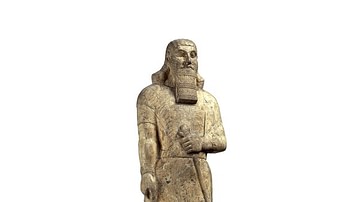
Ashurnasirpal II
Ashurnasirpal II (r. 884-859 BCE) was the third king of the Neo-Assyrian Empire. His father was Tukulti-Ninurta II (r. 891-884 BCE) whose military campaigns throughout the region provided his son with a sizeable empire and the...

Definition
The Seven Wonders
The Seven Wonders of the Ancient World were seven impressive structures famously listed by ancient writers including Philo of Byzantium, Antipater of Sidon, Diodorus Siculus, Herodotus, Strabo, and Callimachus of Cyrene, among...

Image Gallery
A Gallery of Lions of Mesopotamia
The Asiatic lion in Mesopotamia symbolized the forces of chaos, which the king defeated in his role as a champion of order and civilization. Lions appear in works of art from the Early Dynastic Period through the...

Image
Glazed-bricks of the processional street
A close-up view of some glazed-bricks of the side walls of the processional street at Babylon. The street and its Ishtar Gate were built by King Nebuchadnezzar II. From Babylon, Mesopotamia, Iraq. Neo-Babylonian...

Image
Propylaea, Athenian Acropolis
The Propylaea, the monumental gate to the acropolis of Athens. Interior (west) view. Architect: Mnesicles, c. 437–431 BCE.

3D Image
Ishtar Gate Lion
The lion of Goddess Ishtar, Nye Carlsberg Glyptotek (Copenhagen, Denmark). Made with Memento Beta (now ReMake) from AutoDesk. 1-3 The Ishtar Gate in Babylon Nebuchadnezzar (604-562 BCE), the King of Babylon, started a series...
