
Search
Remove Ads
Advertisement
Search Results

Article
Caesarea Maritima's Role in the Roman Empire
Caesarea Maritima, the city Herod the Great (r. 37-4 BCE) built for Rome on the southeastern coast of the Mediterranean served as the Roman Empire's powerbase of operations both commercially and militarily...

Article
Herodotus on Animal Sacrifice in Egypt
II:38. The males of the ox kind they consider to belong to Epaphos, and on account of him they test them in the following manner: If the priest sees one single black hair upon the beast he counts it not clean...

Article
Dadan, Tayma, Khaybar, Qurh & Old Town AlUla - More Stunning Sites at AlUla, Saudi Arabia
Khaybar, Tayma, Dadan, Qurh, and AlUla Old Town are sites situated in the AlUla region of Saudi Arabia, an area on the ancient incense trade routes. Khaybar and Tayma are...
Image
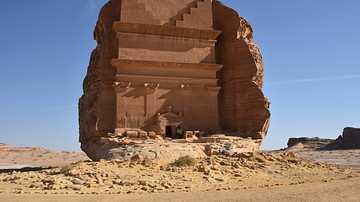
Tomb of the Lion of Kuza, Hegra
The Tomb of the Lion of Kuza (Qasr al-Farid) is a 1st-century CE Nabatean unfinished tomb carved into a single huge rock in Hegra (Madain Saleh) in Saudi Arabia, the Kingdom of Nabatea's second capital after Petra...
Image
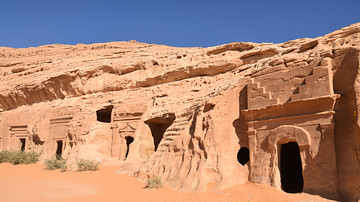
Qasr al-Bint Necropolis in Hegra
The Qasr al-Bint necropolis in Hegra (Mada'in Salih) in modern-day Saudi Arabia is one of the four necropolis areas to have survived. Qasr al-Bint consists of 31 Nabatean tombs dating from 1 to 58 CE. The tombs include...
Image
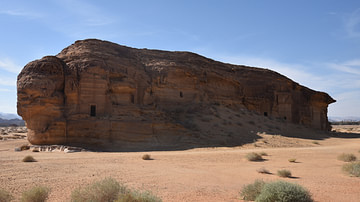
Jabal al-Ahmar Necropolis in Hegra
The Jabal al-Ahmar Necropolis in Hegra (Mada'in Salih) in modern-day Saudi Arabia is one of the four necropolis areas to have survived. It contains 18 tombs, some of which were recently uncovered. The remains of...
Image
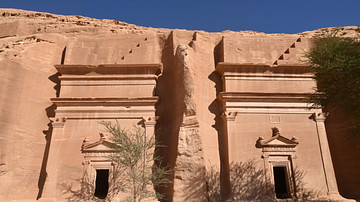
Tombs 21 & 22 of the Qasr al-Bint Necropolis in Hegra
Two tomb façades in Qasr al-Bint (Tombs 21 & 22), one of the necropolises of Hegra (Mada'in Salih) in modern-day Saudi Arabia. Tomb 22 (right) is the oldest dated façade in Hegra (along with Tomb...

Image
Germanic & Christian Tales from the Franks Casket
The left half of this front panel of the casket refers to the Germanic tale of Weland, a smith who was imprisoned and lamed by a legendary king. Weland took revenge by killing the king's sons and turning...
