
Search
Remove Ads
Advertisement
Search Results

Image
Chinese Warring States, 3rd century BCE
A map showing the principle state of the Warring States Period in China c. 260 BCE.

Image
Map of the Trojan War States, c. 1200 BCE
The Bronze Age collapse at the end of the 13th century BCE saw a great many changes in the ancient world. Many second millennium states disappeared entirely, as cities were destroyed and peoples migrated. Others...

Image
Warring States Crossbow Trigger
The trigger and firing mechanism of a crossbow from the Chinese Warring States Period, 3rd century BCE (possible a century later during the Han Dynasty). Bronze inlaid with silver.

Image
Warring States Helmet
A bronze helmet from the Yin state. Warring States Period (481-221 BCE).

Image
Warring States Period Swords
Swords of the Warring States Period (481-221 BCE) in China. The left sword is of iron while the other two are of bronze. (Shaanxi Provincial Museum, Xian, China)

Article
What Were the Consequences of WWII?
The consequences of the Second World War (1939-45) were many and varied. Nazi Germany, Fascist Italy, and military-dominated Japan were all defeated. Many occupied countries were liberated and regained their freedom...

Article
Declaration of Independence
The Declaration of Independence is the foundational document of the United States of America. Written primarily by Thomas Jefferson, it explains why the Thirteen Colonies decided to separate from Great Britain during...
Definition
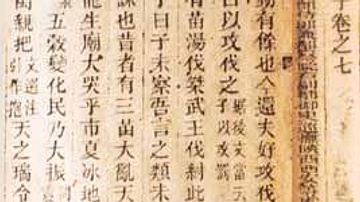
Mo Ti
Mo Ti (l. 470-391 BCE, also known as Mot Tzu, Mozi, and Micius) was a Chinese philosopher of the Warring States Period (c. 481-221 BCE) associated with the Hundred Schools of Thought (different philosophical schools which established...

Definition
Kingdom of Jerusalem
The Kingdom of Jerusalem was a state created in 1099 CE by Crusaders and western settlers after the First Crusade (1095-1102 CE). With Jerusalem as its capital, the kingdom was the most important of the four Crusader States...

Definition
Fugitive Slave Act of 1850 - Northern Resistance and Tubman's Rescue of Charles Nalle
The Fugitive Slave Act of 1850 (1850-1864) was part of the Compromise of 1850, drafted to diffuse tensions between Southern 'slave states' and Northern 'free states.' The...
