
Search
Remove Ads
Advertisement
Search Results

Definition
Hades
Hades was both the name of the ancient Greek god of the underworld (Roman name: Pluto) and the name of the shadowy place below the earth which was considered the final destination for the souls of the dead. Perhaps the most feared of...

Definition
Tyche
In Greek mythology, Tyche is the goddess and personification of good luck, chance, and fortune. Tyche's popularity grew after the Classical period when many cities and officials across the Greek world and the Mediterranean adopted her...

Definition
Thera
Thera is the ancient name for both the island of Santorini in the Greek Cyclades and the name of the volcano which famously erupted on the island in the middle Bronze Age. The 17th century BCE eruption covered Akrotiri, the most important...

Definition
Cyrene
Cyrene (modern-day Shahhat, Libya) was a vital cultural center and port of trade in North Africa founded in 631 BCE by Greek colonists from the island of Thera. The city is best known as the birthplace of the philosopher Aristippus of...
Definition
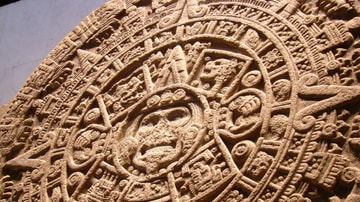
Tonatiuh
Tonatiuh, 'Turquoise Lord,' was the 5th and present sun in the Aztec view of the cosmos and the fierce sun god of several other Postclassic Mesoamerican cultures, including the Toltecs. It was thought that only the regular offering...

Definition
Works and Days
Works and Days is an epic poem written in dactylic hexameter, credited to the 8th-century BCE Greek poet Hesiod. Hesiod is generally remembered for two epic works, Theogony and Works and Days but, like his contemporary Homer, he...

Definition
Illuminated Manuscripts
Illuminated manuscripts were hand-made books, usually on Christian scripture or practice, produced in Western Europe between c. 500-c. 1600. They are so called because of the use of gold and silver which illuminates the...

Definition
Agamemnon (Person)
Agamemnon was the legendary king of Mycenae and leader of the Greek army in the Trojan War of Homer's Illiad. Agamemnon is a great warrior but also a selfish ruler who famously upset his invincible champion Achilles, a feud...

Definition
Ancient Persian Religion
Ancient Persian religion was a polytheistic faith which corresponds roughly to what is known today as ancient Persian mythology. It first developed in the region known as Greater Iran (the Caucasus, Central Asia, South...

Definition
Avesta
The Avesta is the scripture of Zoroastrianism which developed from an oral tradition founded by the prophet Zoroaster (Zarathustra, Zartosht) sometime between c. 1500-1000 BCE. The title is generally accepted as meaning “praise”, though...
