
Search
Remove Ads
Advertisement
Search Results

Article
The Descent of Inanna - A Sumerian Tale of Injustice
The Sumerian poem The Descent of Inanna (circa 1900-1600 BCE) chronicles the journey of Inanna, the great goddess and Queen of Heaven, from her realm in the sky to earth and down into the underworld...

Article
The Ancient Celtic Pantheon
The ancient Celtic pantheon consisted of over 400 gods and goddesses who represented everything from rivers to warfare. With perhaps the exception of Lugh, the Celtic gods were not universally worshipped across Iron Age...

Article
Badger-Woman
Badger-Woman is a story of the Arapaho nation about a noble young hunter who refuses the advances of his sister-in-law and is then betrayed by her. The tale is similar to those of other civilizations, notably Two Brothers (The Fate...

Article
The Women of Athena's Cult
In ancient Athens, women had no life outside the home unless they were prostitutes or were engaged in religious activities such as festivals. Every Greek deity in every city-state had their own cult (sect) but the cult...

Article
The World's Oldest Love Poem - The Love Song for Shu-Sin
The world's oldest love poem is The Love Song for Shu-Sin (written circa 2000 BCE), composed in ancient Mesopotamia for use in part of the sacred rites of fertility. Prior to its discovery in the...

Article
The Legendary Settlement of Iceland
It is said that the early Norse settlers of Iceland in the Viking Age (c. 790-1100 CE) believed it was the home of the gods because of the tale of the creation of the world in Norse religion. In the time before...

Article
The Nimrud Ivories - Their Discovery & History
The Nimrud Ivories are a vast collection of figures, panels, and plaques, carved from ivory, dated to the 9th to 7th centuries BCE, discovered in the ruins of the ancient city of Nimrud. Today, they are...
Article
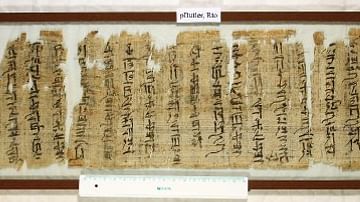
The Eloquent Peasant & Egyptian Justice
The Tale of the Eloquent Peasant is a literary work from the Middle Kingdom of Egypt (2040-1782 BCE) which illustrates the value society placed on the concept of justice and equality under the law. In the story...

Article
Hymn to Nungal - A Praise Song for the Sumerian Goddess of Prisons
The Hymn to Nungal (circa 1894-1595 BCE) is a Sumerian poem praising Nungal, the goddess of prisons and rehabilitation (also associated with the underworld), as well as the prison house...

Article
Mesopotamian City Laments - Suffering And The Will Of The Gods
The question "Why do bad things happen to good people?" has been asked for millennia, probably since before writing was invented, but at least since circa 1700 BCE when the Sumerian (and later...
