
Search
Remove Ads
Advertisement
Search Results

Definition
Fifth Crusade
The Fifth Crusade (1217-1221 CE) was called by Pope Innocent III (r. 1198-1216 CE) with the objective, like previous crusades, of recapturing Jerusalem from Muslim control; only this time the strategy was to weaken the enemy by...

Definition
Portuguese Macao
Macao (Macau) is located on a peninsula in the estuary of the Pearl River delta in southeast China and it was a Portuguese colonial settlement from c. 1557 until 1999. Macao was a major trade hub of the Portuguese Empire and with...

Definition
Mesopotamian Literature - The Earliest Works of the Imagination
Ancient Mesopotamian literature developed circa 2600 BCE after scribes, who had formerly been record-keepers, began composing original works in the region of Sumer. The Sumerians invented writing...

Definition
War of the Sixth Coalition
The War of the Sixth Coalition (1813-1814), known in Germany as the Wars of Liberation, was the penultimate conflict of the Napoleonic Wars (1803-1815). The Sixth Coalition, which included Russia, Austria, Prussia, the...

Definition
Wall
The English word 'wall' is derived from the Latin, vallus meaning 'a stake' or 'post' and designated the wood-stake and earth palisade which formed the outer edge of a fortification. The palisades were in use early on and are mentioned...

Definition
Amun
Amun (also Amon, Ammon, Amen, Amun-Ra) is the ancient Egyptian god of the sun and air. He is one of the most important gods of ancient Egypt who rose to prominence at Thebes at the beginning of the period of the New Kingdom (c. 1570-1069...

Definition
Early Dynastic Period in Mesopotamia - Era of Many of the "Firsts" in Civilization
The Early Dynastic period in Mesopotamia is the modern-day archaeological term for the era in Mesopotamian history – circa 2900 to circa 2350/2334 BCE – during which some of...

Definition
Tutankhamun
Tutankhamun (also known as Tutankhamen and `King Tut', r. c.1336-c.1327 BCE) is the most famous and instantly recognizable Pharaoh in the modern world. His golden sarcophagus is now a symbol almost synonymous with Egypt. His name...

Definition
Silla
The Silla kingdom ruled south-eastern Korea during the Three Kingdoms period from the 1st century BCE to 7th century CE. The capital was Geumseong (Gyeongju) with a centralised government and hierarchical system of social ranks. The prosperity...
Definition
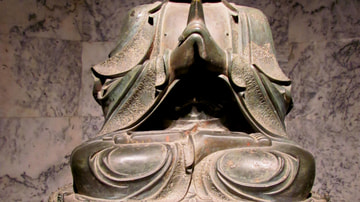
Esoteric Buddhism
Esoteric Buddhism is the mystical interpretation and practice of the belief system founded by the Buddha (known as Sakyamuni Buddha, l. c. 563 - c. 483 BCE). It is known by several names and is characterized by a personal relationship...
