
Search
Remove Ads
Advertisement
Search Results

Definition
Attila the Hun
Attila the Hun (r. 434-453 CE) was the leader of the ancient nomadic people known as the Huns and ruler of the Hunnic Empire, which he established. His name means "Little Father" and, according to some historians, may not have...

Definition
Maya Religion
Maya religious beliefs are formed on the notion that virtually everything in the world contains k'uh, or sacredness. K'uh and k'uhul, similar terms which are used to explain the spirituality of all inanimate and animate things...

Definition
Selene
Selene (also known as Mene) is the personification and goddess of the moon in Greek mythology. Every night, she travels across the sky in her chariot, pulling the moon behind her. Selene is the daughter of the Titans Hyperion and Theia...

Definition
Assur - The Supreme God of the Ancient Assyrians
Assur (also Ashur, Anshar) is the god of the ancient Assyrians who was elevated from a local deity of the city of Ashur to the supreme god of the Assyrian pantheon. His attributes were drawn from earlier...

Definition
Ancient India
India is a country in South Asia whose name comes from the Indus River. The name 'Bharata' is used as a designation for the country in their constitution referencing the ancient mythological emperor, Bharata, whose story is told...

Definition
Mesopotamia - The Beginning of Beginnings
Mesopotamia (from the Greek, meaning "between two rivers") was an ancient region located in the Near East (Middle East) bounded in the northeast by the Zagros Mountains and in the southeast by the Arabian Plateau...

Definition
Labyrinth
The word labyrinth comes from the Greek labyrinthos and describes any maze-like structure with a single path through it which differentiates it from an actual maze which may have multiple paths intricately linked. Etymologically the...
Definition
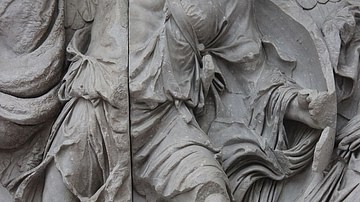
Uranus
Uranus (also spelt Ouranos) is the personification of heaven and the sky in Greek mythology. His Roman counterpart is Caelus. Gaia (Earth) gave birth to Uranus and chose him to be her equal. She lay with him, resulting in the birth of...

Definition
Marduk - The Great God of Babylon
Marduk was the patron god of Babylon who presided over justice, compassion, healing, regeneration, magic, and fairness, although he is also sometimes referenced as a storm god and agricultural deity. He rose to prominence...

Definition
Ptolemaic Egypt
Ptolemaic Egypt existed between 323 and 30 BCE when Egypt was ruled by the Macedonian Ptolemaic dynasty. During the Ptolemaic period, Egyptian society changed as Greek immigrants introduced a new language, religious pantheon...
