
Search
Did you mean: Levant?
Remove Ads
Advertisement
Search Results

Article
Chola Art & Architecture
Like many great civilisations, the origins of the Chola, a Tamil Hindu dynasty in southern India, are shrouded in the temporal mists of uncertainty and obscurity. It is however known that they were influential from at least...

Article
Conflict & Celts: The Creation of Ancient Galatia
Galatia was the most long-lasting and powerful Celtic settlement outside of Europe. It was the only kingdom of note to be forged during the Celtic invasions of the Mediterranean in the 4th and 3rd centuries...
Article
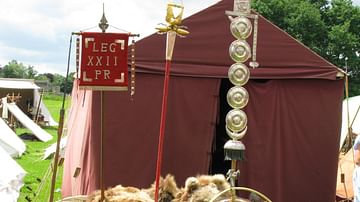
Legions of the Rhine Frontier
After Julius Caesar’s (100-44 BCE) conquest of Gaul, Roman legions pushed the borders of the Roman Empire’s frontier to the banks of the Rhine River. Augustus (r. 27 BCE - 14 CE) divided the newly acquired region into...

Video
Bernini Obelisk - Ancient Rome Live
The Bernini Obelisk (also known as the "Minervio" or "the Elephant and Obelisk") is a sculpture from Rome. The obelisk was originally from Sais, Egypt and was brought to Rome by Emperor Diocletian (r. 284-305 CE...

Video
When Money Talks: A History of Coins and Numismatics with Frank Holt
When Money Talks: A History of Coins and Numismatics by Frank Holt explores the history of coins from their first invention in ancient Lydia, all the way up to cryptocurrency and the future...

Image
Cleopatra Selene II, Boscoreale
The allegorical portrait on this silver emblema dish is attributed to Cleopatra Selene II (40 BCE–c. 5 BCE), the daughter of Cleopatra VII (69-30 BCE) and Mark Antony (83–30 BCE). She wears an elephant scalp as a headdress...

Image
Swiss Colonial Science
Swiss colonial science. Fritz and Paul Sarasin were scientists who travelled to British controlled Ceylon and Dutch ruled Celebes during the last decades of the 19th century. The elephant slain here had a calf that was shipped...

Image
Mauryan and Pre-Mauryan soldiers from the Sanchi Stupa
Details of what chariots, war elephants and cavalry would have looked like in the 5th century BCE. In all probability, this is how the Magadhan soldiers looked. Details taken from the “War over the...

Image
Battle of Zama
A 16th century CE painting depicting the Battle of Zama between Rome and Carthage in 202 BCE.

Image
Carthaginian War Elephants
An artist's impression of what an attack by Carthaginian war elephants may have looked like during the Punic Wars of the 3rd century BCE.
