
Search
Remove Ads
Advertisement
Search Results

Definition
Daedalus
Daedalus is a figure from Greek mythology famous for his sculptures, clever inventions, and as the architect of the Minotaur's labyrinth on Crete. Daedalus is the father of Icarus who flew too close to the Sun on his artificial wings...

Article
Ships of the Gods of Ancient Egypt
The Nile River was the source of life for the ancient Egyptians and so figured prominently in their religious beliefs. At night, the Milky Way was considered a heavenly Nile, associated with Hathor, and provider...

Article
Ethnicity & Identity Within the Four-Room House
The process of determining ethnicity is a problematic venture, even more so when interpreted through the archaeological record. Despite this issue, evidence, such as the four-room house, has been preserved...

Definition
Unified Silla Kingdom
The Unified Silla Kingdom (668- 935 CE) was the first dynasty to rule over the whole of the Korean peninsula. After centuries of battles with the other states of the Three Kingdoms Period (57 BCE - 668 CE) Silla benefitted...

Definition
Giza
Giza is a plateau southwest of modern Cairo which served as the necropolis for the royalty of the Old Kingdom of Egypt. Most famous for the pyramids of Khufu (completed c. 2560 BCE) Khafre (c. 2530 BCE) and Menkaure (c. 2510 BCE) and the...

Definition
Amenhotep III
Amenhotep III (c. 1386-1353 BCE) was the ninth king of the 18th Dynasty of Egypt. He is also known as Nebma'atre, Amenophis III, Amunhotep II, and Amana-Hatpa, all of which relate to the concept of the god Amun being satisfied or...

Definition
Arsinoe II Philadelphus
Arsinoe II (l. c. 318/311 - c. 270/268 BCE), daughter of Ptolemy I became one of the most enduring figures of the Lagid or Ptolemaic Dynasty and left an undeniable mark in the historical evidence. She was married three times...
Article
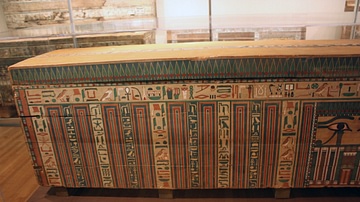
The Coffin Texts
The Coffin Texts (c. 2134-2040 BCE) are 1,185 spells, incantations, and other forms of religious writing inscribed on coffins to help the deceased navigate the afterlife. They include the text known as the Book of Two Ways which...

Article
The Soul in Ancient Egypt
At the beginning of time, the god Atum stood on the primordial mound in the midst of the waters of chaos and created the world. The power which enabled this act was heka (magic) personified in the god Heka, the invisible...

Article
Queen Hatshepsut: Daughter of Amun, Pharaoh of Egypt
Hatshepsut, whose name means "Foremost of Noble Women" or "First Among Noble Women" (royal name, Ma'at-ka-re, translated as "spirit of harmony and truth") was the fifth ruler of the 18th Dynasty (r...
