
Search
Remove Ads
Advertisement
Search Results

Definition
Ancient Celtic Art
Art, along with language, is perhaps the best way to see the connections between the ancient peoples we label as Celts who lived in Iron Age Europe. There were great variations across time and space but common features of ancient...

Image
Kukulcan Sculpture, Chichen Itza
A representation of the feathered-serpent god Kukulkan at the base of the Castillo or Pyramid of Kukulcan at the Maya (and possibly later Toltec) centre of Chichen Itza, Yucatan, Mexico. The pyramid was built prior...

Image
Nok Sculpture
A terracotta figurine produced by the Nok Culture of southern West Africa (500 BCE - 200 CE). (Louvre Museum, Paris)
Image
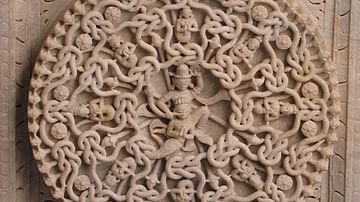
Karma, Ceiling Sculpture, Ranakpur
A ceiling decoration from a Jain temple in Ranakpur, Rajasthan, India. The knots represent the interlinking notion of karma.
Image
Göbekli Tepe, Pillar with Sculpture of a Fox
Göbekli Tepe is a c. 12,000-year-old archaeological site in Anatolia, Turkey. One characteristic feature of the site is the abundance of monumental stone pillars, often arranged in a circle and elaborately...
Image
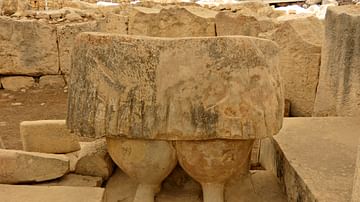
Tarxien Stone Sculpture with Pleated Skirt
Mother goddess' statue with a pleated skirt found outside of the South Temple of the Tarxien Temples, Malta, c. 3000-2500 BCE.

Video
Lost History: The Terracotta Sculpture of Djenné Djenno
Seated figure, 13th century, Mali, Inland Niger Delta (Djenné peoples), terracotta, 25.4 x 29.9cm (The Metropolitan Museum of Art) ARCHES: At Risk Cultural Heritage Education Series Speakers...

Image
Sculpture of Atropates
Atropates, (370 BCE to c. 321 BCE), a Median nobleman and Persian general who served under Darius III and Alexander the Great, and eventually founded an independent kingdom Media-Atropatene (Lesser Media) and dynasty that...
Article
Grave Goods in Ancient Egypt
The concept of the afterlife changed in different eras of Egypt's very long history, but for the most part, it was imagined as a paradise where one lived eternally. To the Egyptians, their country was the most perfect...

Article
Setna II: A Detailed Summary & Commentary
Setna II (also Setna Khaemaus and Si-Osire) is a work of ancient Egyptian literature from Roman Egypt (30 BCE - 646 CE) written in demotic script. It is part of a cycle of stories known as the Tales of Prince...
