
Search
Remove Ads
Advertisement
Search Results

Article
Pets in Ancient Egypt
Pets were very important to the ancient Egyptians and considered gifts from the gods to be cared for until their death when they were expected to be returned to the divine realm from which they had come. In life, pets were...

Article
The Admonitions of Ipuwer - A Tale of Chaos and the Importance of Government
The Admonitions of Ipuwer (also known as The Papyrus Ipuwer and The Admonitions of an Egyptian Sage) is a literary text dated to the Middle Kingdom of Egypt (2040-1782 BCE). The...

Definition
Fayum
The Faiyum (also given as Fayoum, Fayum, and Faiyum Oasis) was a region of ancient Egypt known for its fertility and the abundance of plant and animal life. Located 62 miles (100 kilometers) south of Memphis (modern Cairo), the Faiyum...

Definition
Nile
The world's longest river, located in Egypt, the Nile flows 4,132 miles (6,650 kilometres) northward to the Mediterranean Sea (a very unusual direction for a river to take). It was considered the source of life by the ancient Egyptians...
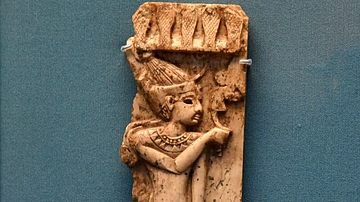
Image
Nimrud Ivory Panel of an Egyptian king
Never seen by the public before 2011. A small fragment of an ivory plaque from Nimrud. The depicted/carved man wears the double crown of Egypt and a royal costume. Phoenician art. Neo-Assyrian Period, 9th to...
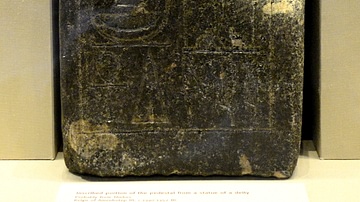
Image
Inscribed Egyptian Statue Pedestal
This inscription has been cut, at an unknown date, from the corner of a statue of a god, one in a series created for the jubilee of pharaoh Amenhotep III in circa 1360 BCE. The god is named in the hieroglyphic inecription...

Image
Ancient Egyptian Sandal
Dating to 400-600 C.E., this pair of sandals features extensive leather-tooled decoration on the footbed, a design detail would have only been appreciated when the sandals were removed. From the Bata Shoe Museum collection...

Image
Model of an Egyptian Granary
Model of a granary. Wood. From Egypt, precise provenance is unknown. Middle Kingdom, 12th Dynasty, c. 1800 BCE. (The Neues Museum, Berlin, Germany).

Image
Egyptian Statuette of a Peasant Using a Hoe
This painted wooden statuette depicts a man wearing a kilt and holding what appears to be a hoe or a mattock. Old Kingdom, 6th Dynasty, 2345-2181 BCE. From tomb 45 at Asyut, modern-day Egypt. (The British...

Image
Egyptian Grinding Grain
This limestone statuette depicts a servant grinding grain on what appears to be a quern. Figurines and statuettes were placed insides tombs as early as the 1st Dynasty (3100-2890 BCE). The majority of them are doing bakery...
