
Search
Remove Ads
Advertisement
Search Results

Definition
Serket
Serket (also known as Serqet, Selkis, and Selket) is an Egyptian goddess of protection associated with the scorpion. She was worshipped widely in Lower Egypt as a great Mother Goddess in the Predynastic Period (c. 6000- c. 3150 BCE) and...
Image
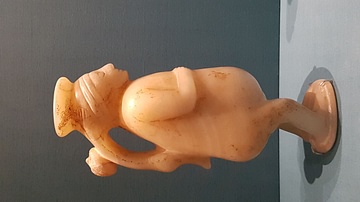
Egyptian Vase In the Form Of A Pregnant Woman
Egyptian calcite vessel in the form of a pregnant woman. Its handle represents a child holding the woman's hair. 18th Dynasty, about 1479-1352 BCE. Found in Tomb 949, Abydos, Egypt. The British Museum...
Image
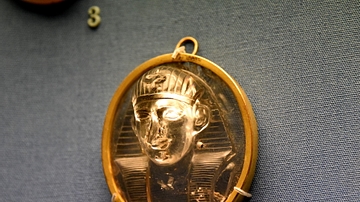
Cameo of an Egyptian King
This rock-crystal cameo depicts a king in an Egyptian style; popular in Italy, where it was probably made. Roman period, 1st century CE. (The British Museum, London).

Image
Egyptian Governor Hori
Seated figure of the Egyptian governor Hori with an inscription of a prayer to the god Ptah-Soker-Osiris. Basalt. Middle Kingdom, 13th Dynasty, 1750-1700 BCE. From Egypt, precise provenance unknown. It is on display at the...
Image
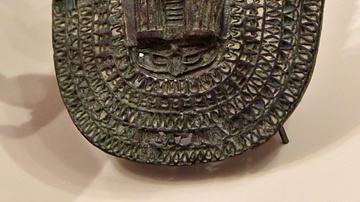
Egyptian Aegis
Egyptian aegis with the head of the goddess Hathor. Her headdress is composed of uraei (rearing cobras) beneath a sun-disc and cow's horns. Bronze. From Egypt, precise provenance is unknown. Third Intermediate Period, 26th Dynasty...
Image
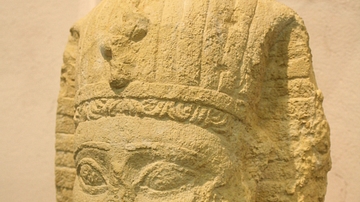
Egyptian Sphinx Head
Limestone sphinx head from the Ptolemaic period, Medinet Madi, Temple of Isis-Thermutis. (Egyptian Museum, Castello Sforzesco, Milan)

Image
Egyptian Baboon Sculpture
This ancient Egyptian sculpture made of basalt dates from the 13th century BCE and depicts a seated baboon. The baboon was associated with Thoth—the god of wisdom, science, and measurement. Baboons were thus often represented...

Image
Ancient Egyptian Dignitary from Memphis
This relief made around c. 1250 BCE depicts what a male dignitary or government official from the ancient Egyptian city of Memphis would look like during the New Kingdom Period (c. 1550-1077 BCE). This stone...
Image
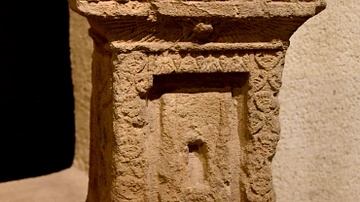
Egyptian-Type Votive Altar from Sidon
This marble votive stele has an Egyptian style (note the row of uraeus cobras at the top). First half of the 5th century BCE. From Sidon, in modern-day Lebanon. (Museum of Archaeology, Istanbul, Turkey).

Image
Egyptian Painting of Syrian Bears
This painted limestone fragment came from the mortuary temple of the Egyptian Pharaoh Sahure at Abusir, Egypt. It depicts Syrian bears and a vessel (possibly tributary). Old Kingdom, 5th Dynasty, 2496-2483 BCE. On...
