
Search
Remove Ads
Advertisement
Search Results

Definition
Aztec Civilization - The Last Mesoamerican Empire
The Aztec Empire (c. 1345-1521) covered at its greatest extent most of northern Mesoamerica. Aztec warriors were able to dominate their neighbouring states and permit rulers such as Montezuma to impose...

Article
Women in World War I - Changing Roles & Rights
During the First World War (1914-18), as governments sought to field the largest armies possible and so conscripted millions of men to the fighting fronts, the role of women in society was greatly expanded...

Article
Prehistoric Hunter-Gatherer Societies
Hunter-gatherer societies are – true to their astoundingly descriptive name – cultures in which human beings obtain their food by hunting, fishing, scavenging, and gathering wild plants and other edibles. Although...

Article
The Impact of the British Industrial Revolution
The consequences of the British Industrial Revolution (1760-1840) were many, varied, and long-lasting. Working life in rural and urban settings was changed forever by the inventions of new machines, the...

Article
The Portuguese Colonization of the Azores
The Azores (Açores) are a North Atlantic island group, which was uninhabited before being colonized by the Portuguese from 1439. The Azores were strategically important for Portuguese mariners to use as a stepping...

Definition
Giza
Giza is a plateau southwest of modern Cairo which served as the necropolis for the royalty of the Old Kingdom of Egypt. Most famous for the pyramids of Khufu (completed c. 2560 BCE) Khafre (c. 2530 BCE) and Menkaure (c. 2510 BCE) and the...

Definition
Amenhotep III
Amenhotep III (c. 1386-1353 BCE) was the ninth king of the 18th Dynasty of Egypt. He is also known as Nebma'atre, Amenophis III, Amunhotep II, and Amana-Hatpa, all of which relate to the concept of the god Amun being satisfied or...
Article
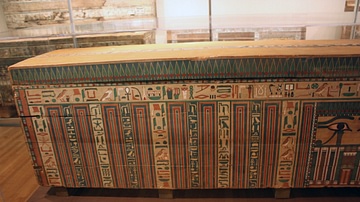
The Coffin Texts
The Coffin Texts (c. 2134-2040 BCE) are 1,185 spells, incantations, and other forms of religious writing inscribed on coffins to help the deceased navigate the afterlife. They include the text known as the Book of Two Ways which...

Article
The Soul in Ancient Egypt
At the beginning of time, the god Atum stood on the primordial mound in the midst of the waters of chaos and created the world. The power which enabled this act was heka (magic) personified in the god Heka, the invisible...

Article
Queen Hatshepsut: Daughter of Amun, Pharaoh of Egypt
Hatshepsut, whose name means "Foremost of Noble Women" or "First Among Noble Women" (royal name, Ma'at-ka-re, translated as "spirit of harmony and truth") was the fifth ruler of the 18th Dynasty (r...
