
Search
Did you mean: Eos?
Remove Ads
Advertisement
Search Results
Article
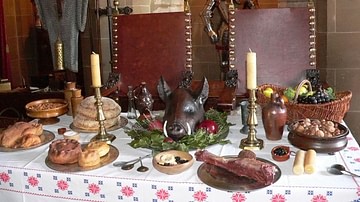
Food in an English Medieval Castle
If one was looking to enjoy a fine meal in the medieval world then the best place to find a handsomely laid dinner table was in the local castle. There, in the magnificent Great Hall, feasts were regularly served...

Article
A Brief History of Genetics - How Genetics Transformed Medicine and Identity
Genetics is the study of how genes are transmitted across generations, which includes the genetic information that produces an individual's traits, physical characteristics, and...
Image
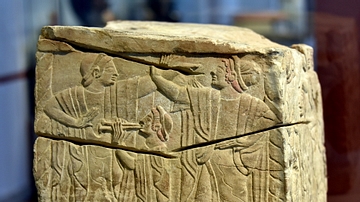
Dancing Girls & Young Men on Cippus
Square-shaped cippi were found inside burial chambers and carried an egg-shaped top, possibly as a symbol of life and fertility. The scenes depicted in bas-reliefs are connected with cult of the dead and burial...

Image
Architectural Pediment from Ulpia Oescus
Architectural Pediment from Ulpia Oescus, photograph by Carole Raddato, Bulgaria, 02 April, 2018. Carved architectural pediment from one of the monumental buildings of Ulpia Oescus, near modern Gigen, Bulgaria...
Image
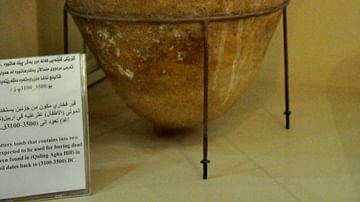
Pottery Tomb
This pottery tomb is composed of two parts and is in the shape of an egg. It was probably used for burying dead children. From Tell Qaling Agha at modern Erbil Governorate, Iraq. 3500-3100 BCE. Erbil Civilization Museum, Iraq.

Image
Capital, Rock-Cut Tombs of Qizqapan
Detail showing the capital of the left-sided engaged column at the façade of the rock-cut tombs of Ashkawt-I Qizqapan (Kurdish: The Cave of the Ravisher or the Cave of the Raped/Abducted Girl). The capital is of...

Image
St George Slaying the Dragon
St George slaying the dragon. From a Macedonian workshop. Made from wood and egg tempera. Dating to the second half of the 16th century. (Hellenic Museum, Melbourne, Victoria).

Image
Funerary Stele from Dascylium
This is the upper part of a long and narrow stele depicting a funerary cortege in two scenes. In the upper scene, two mourning women walk behind a funeral cart. In the lower scene, a woman and a bearded man sit on a...

Image Gallery
A Gallery of Fabergé Eggs
The tradition of giving miniature Easter eggs was not a new one but when Tsar Alexander III (r. 1881-1894) commissioned Peter Carl Fabergé (1846-1920) to make one for Easter in 1885, a legend was born. Over 50 eggs were...

Video
Top 5 Facts - Aristotle
A pioneering philosopher and one of the most pivotal in a line of great men who informed our understanding of the world; here are 5 facts about Aristotle. For more historical facts and features, visit http://www.historyanswers.co.uk/...
