
Search
Remove Ads
Advertisement
Search Results

Definition
Walt Whitman
Walt Whitman (1819-1892) was an American journalist and poet, best known for his collection of poems entitled Leaves of Grass, first published in 1855. He remains an influential figure in American literature, whose writings reflect...

Definition
Henry Clay - The Great Compromiser
Henry Clay (1777-1852) was an American lawyer and statesman, one of the defining political figures of his age. Over the course of his several decades on the stage of national politics, Clay helped lead the United...

Definition
Transatlantic Slave Trade - The Shame of Nations
The transatlantic slave trade (also given as the Atlantic slave trade, circa 1492 to 1860) was the practice of enslaving the citizens of African states and transporting them across the Atlantic Ocean to...

Definition
Sofonisba Anguissola - The Founder of Feminist Art
Sofonisba Anguissola (c. 1532-1625) was an Italian Renaissance painter from Cremona who achieved considerable fame during her lifetime as the first widely-known female artist. She was invited by the...

Definition
Black Codes - Slavery Under a New Name During Reconstruction
The Black Codes were a series of racist and discriminatory policies enacted by several former slave states in the United States during the early years of the Reconstruction Era (circa 1865-1877...

Definition
Ancient Celts
The ancient Celts were various tribal groups living in parts of western and central Europe in the Late Bronze Age and through the Iron Age (c. 700 BCE to c. 400 CE). Given the name Celts by ancient writers, these tribes and their...

Definition
Strabo of Amasia - Author of the 1st-Century Geography
Strabo of Amasia (c. (c. 64 BCE - c. 24 CE) was the author of Geography, a 17-book geography of the world as it was known to the Greeks and Romans of the time, extending from Iberia and Mauria (Mauretania...

Definition
Nebuchadnezzar II
Nebuchadnezzar II (r. 605/604-562 BCE) was the greatest King of ancient Babylon during the period of the Neo-Babylonian Empire (626-539 BCE), succeeding its founder, his father, Nabopolassar (r. 626-605 BCE). He is best known...
Definition
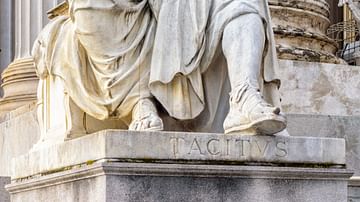
Tacitus
Publius Cornelius Tacitus (l. c. 56 - c. 118 CE) was a Roman historian, active throughout the reign of Trajan (r. 98-117 CE) and the early years of Hadrian (r. 117-138 CE). His best-known works are Histories and Annals, which cover the...

Definition
Unified Silla Kingdom
The Unified Silla Kingdom (668- 935 CE) was the first dynasty to rule over the whole of the Korean peninsula. After centuries of battles with the other states of the Three Kingdoms Period (57 BCE - 668 CE) Silla benefitted...
