
Search
Remove Ads
Advertisement
Search Results

Definition
Louis XVI of France
Louis XVI (l. 1754-1793) was the last king of France (r. 1774-1792) before the monarchy was abolished during the French Revolution (1789-99). An indecisive king, his attempts to navigate France through the crises of the 1780s...

Definition
Jeanne d'Albret
Jeanne d'Albret (Joan III of Navarre, l. 1528-1572) was Queen of Navarre, daughter of Marguerite de Navarre (l. 1492-1549) and niece of King Francois I (Francis I of France, r. 1515-1547). She is best known for leading the Huguenots...

Definition
Peace of Westphalia
The Peace of Westphalia, the name given to the multiple treaties, marked the conclusion of the Thirty Years' War. Signed on 24 October 1648, it aimed to secure political autonomy for the multitude of small states that made...

Definition
Anastasios I
Anastasios I ruled the Byzantine empire from 491 to 518 CE. Although his tax and monetary reforms were both popular and successful, the emperor could not repair the damaging split in the Christian Church created by his predecessors...

Definition
Valerian
Valerian ruled as emperor of the Roman Empire from 253 CE until his capture in 260 CE. In 253 CE an elderly Roman military commander and experienced former senator was proclaimed emperor by his troops - a very common occurrence at the...
Article
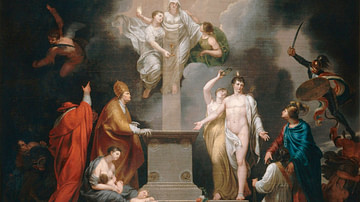
Napoleonic Concordat of 1801 & Religious Pluralism
The Napoleonic Concordat of 1801 defined France's relationship with the Catholic Church for over 100 years. The Organic Articles were added in 1802 and provided state recognition of the Reformed and...

Article
War of the Eight Princes
The War of the Eight Princes (291-306 CE) is the conflict which weakened and finally ended the Western Jin Dynasty (266-316 CE) in China and resulted in more far-reaching consequences throughout the country. The power of...

Article
The Monastic Movement: Origins & Purposes
In 313 CE, Constantine the Great (272 – 337 CE) ended the sporadic-yet-terrifying Christian persecutions under the Roman Empire with his “Edict of Milan,” and brought the Christian church under imperial protection...

Article
The Ideal of Christendom in Antiquity
The ideal of Christendom is a historical and political vision where society and government are unified under the Christian faith. According to this vision, power on Earth is divided between the church through...

Definition
Merovingian Dynasty
The Merovingian Dynasty was the ruling family of the Franks from roughly 481 when Clovis I ascended the throne of the Salian Franks until 751 when Childeric III was deposed and the Merovingians were supplanted by the Carolingian...
