
Search
Remove Ads
Advertisement
Search Results

Definition
William the Silent
William the Silent (l. 1533-1584, also known as William of Orange) was the leader of the Dutch Revolt (the Eighty Years' War) in the Netherlands; first politically (between 1559-1568) then militarily (between 1568-1584). He...

Definition
Battle of Neerwinden
The Battle of Neerwinden saw the major defeat of a French republican army by an allied force of Austrians and Dutch during the War of the First Coalition (1792-97), part of the broader French Revolutionary Wars (1792-1802...

Article
The Journeys of Paul the Apostle
The journeys of Paul the Apostle, as the New Testament relates in the Book of Acts, started with his conversion experience on the way to Damascus, after which instead of seeking to thwart the growing Christian movement...

Article
Reformation in the Netherlands & the Eighty Years' War
The Protestant Reformation in the Netherlands was among the most violent and destructive of any region during the first 50 years of the movement, ultimately informing the Eighty Years' War (1568-1648...

Article
La Rochelle, a Protestant Stronghold of the French Reformation
La Rochelle emerged early in the French Reformation as a Protestant political and military center. The city's fortifications withstood repeated sieges over the years. In 1627, La Rochelle was...

Image
Map of the Growth of Christianity in the Roman Empire - From Early Communities to Imperial Christianity, 30–451
The growth of Christianity in the Roman Empire from the 1st to the 5th centuries transformed a small religious movement rooted in Roman Judaea into one...

Definition
Horemheb
Horemheb (reigned 1320-1292 BCE) was the last pharaoh of the 18th dynasty of Egypt. He is also known as Dejserkheprure and Horemhab. His name means, “Horus is in Festival” and he came from the lower classes of Egypt, worked himself...

Definition
Louis I de Bourbon, Prince of Condé
Louis I de Bourbon (l. 1530-1569) was a descendant of Louis IX of France (r. 1226-1270) and founder of the House of Condé. The Prince of Condé proved his valor as a Huguenot military leader during the first three...
Article
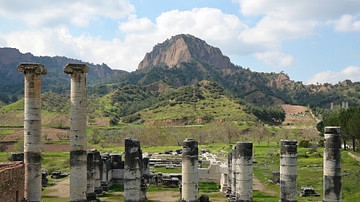
Melito of Sardis and his Apology for Christianity
Melito of Sardis (d. c. 180 CE) was a bishop in the city of Sardis (near modern-day Sart, Turkey) who was regarded as one of the greatest Christian thinkers, writers, and apologists of his time. In the...

Article
War of the Eight Princes
The War of the Eight Princes (291-306 CE) is the conflict which weakened and finally ended the Western Jin Dynasty (266-316 CE) in China and resulted in more far-reaching consequences throughout the country. The power of...
