
Search
Remove Ads
Advertisement
Search Results

Definition
Yongle Emperor
The Yongle Emperor (aka Chengzu or Yung Lo, r. 1403-1424 CE) was the third ruler of the Chinese Ming Dynasty (1368-1644 CE). Inheriting a stable state thanks to the work of his father, the Hongwu Emperor (r. 1368-1398 CE), Yongle...

Article
Armour in Ancient Chinese Warfare
With zinging arrows, powerful crossbow bolts, stabbing swords, and swinging axes all a staple feature of the Chinese battlefield, it is not surprising that soldiers sought to protect themselves as best they could...

Article
Fortifications in Ancient Chinese Warfare
While ancient Chinese warfare was often characterised by large armies in pitched battles, siege warfare and the sacking of cities were also regular features. Huge earth walls with towers and encircling ditches...

Definition
Leo III
Leo III was emperor of the Byzantine Empire from 717 to 741 CE. He founded the Isaurian dynasty which ruled until 802 CE. The emperor was a talented administrator, and he revamped the empire's political apparatus and legal code. Leo's...
Definition
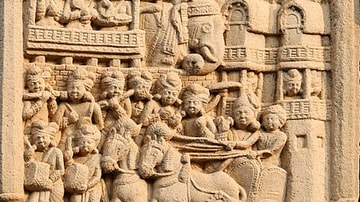
Ajatashatru
Ajatashatru (c. 493/492 BCE - c. 462/460 BCE) was the second important king of the Haryanka Dynasty, who came to the throne of Magadha by deposing and executing his own father Bimbisara. The Haryanka Dynasty (c. 545/544 BCE - c. 413...

Definition
Magadha Kingdom
Magadha was an ancient kingdom located on the Indo-Gangetic plains in eastern India and spread over what is today the modern state of Bihar. At the height of its power, it claimed suzerainty over the entire eastern part of the...

Article
Paul's Journeys and the Mediterranean Trade
Mediterranean trade increased exponentially at the turn of the first millennium. During Rome's zenith, goods of all sorts began to move in all directions. As a common traveler aboard merchant ships, Paul...

Definition
Mongol Warfare
The Mongols conquered vast swathes of Asia in the 13th and 14th century CE thanks to their fast light cavalry and excellent bowmen, but another significant contribution to their success was the adoption of their enemies' tactics...

Definition
Ancient Korean Coinage
The coinage of ancient Korea (pre-13th century CE) first employed Chinese coins, known locally as the oshuchon. Korean rulers began minting their own metal coins from the late 10th century CE, first in copper and iron, and...

Definition
Byzantine Architecture
The architecture of the Byzantine Empire (4th - 15th century CE) continued its early Roman traditions but architects also added new structures to their already formidable repertoire, notably improved fortification walls and...
