
Search
Did you mean: Didache?

 This answer was generated by
 Search Results

Definition
Wars of the Diadochi
On June 10, 323 BCE Alexander the Great died in Babylon. Although historians have debated the exact cause most agree that the empire he built was left without adequate leadership for there was no clear successor or heir. The military commanders...
Image
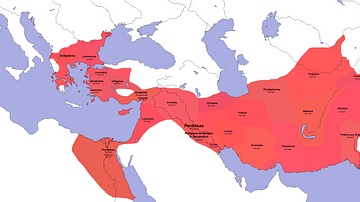
Diadochi Satraps 323 BCE
The Diadochi satraps following the agreement made in Babylon in 323 BCE.

Definition
Thessalonike of Macedon
Thessalonike of Macedon (c. 345-295 BCE) was the daughter of Philip II of Macedon (r. 359-336 BCE) and one of his several consorts, Nikesipolis of Pherae (also spelt Nicesipolis). Born to the Argead family of Macedonian rulers like her half-brother...

Definition
Cleopatra of Macedon
Cleopatra of Macedon (355/4-308 BCE), daughter of Philip II of Macedon (reign 359-336 BCE) and his Molossian queen, Olympias of Epirus (c. 375-316 BCE), was the only full sister of Alexander the Great (reign 336-323 BCE). Born in Pella, the...

Definition
Alexander the Great
Alexander III of Macedon, better known as Alexander the Great (l. 21 July 356 BCE – 10 or 11 June 323 BCE, r. 336-323 BCE), was the son of King Philip II of Macedon (r. 359-336 BCE) who became king upon his father's death in 336 BCE and then...

Definition
Ptolemaic Dynasty
The Ptolemaic dynasty was a Macedonian royal family that ruled Ptolemaic Egypt from 323 to 30 BCE. It was founded by Ptolemy I, a general and successor of Alexander the Great. They built Alexandria, including the Lighthouse of Alexandria...

Definition
Macedon
Macedon was an ancient kingdom located in the north of the Greek peninsula first inhabited by the Mackednoi tribe who, according to Herodotus, were the first to call themselves 'Hellenes' (later applied to all Greeks) and who gave the land...
Definition
Hellenistic Period
The Hellenistic Period is a part of the Ancient Period for the European and Near Asian space. The use of this period is justified by the extent of the Hellenic culture in most of these areas, due to the Greek political presence especially...
Definition
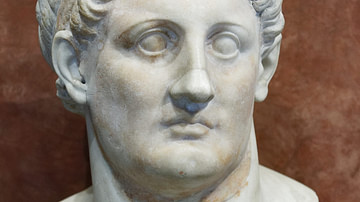
Ptolemy I
Ptolemy I Soter (366-282 BCE) was one of the successor kings to the empire of Alexander the Great. He served not only as king of Egypt but also the founder of the Ptolemaic Dynasty, a dynasty which included the infamous Cleopatra VII. Early...

Definition
Seleucus I Nicator
Seleucus I Nicator (l. c. 358-281 BCE, r. 305-281 BCE) was one of the generals of Alexander the Great (l. 356-323 BCE) who made up the group of Diadochi ("successors") who divided the vast Macedonian Empire between them after the death of...
