
Search
Remove Ads
Advertisement
Search Results

Lesson Pack
Mesopotamia: Empires & Warfare
This lesson pack on empires and warfare in ancient Mesopotamia includes the following content: Two Lesson Plans - Assyrian & Akkadian Empires - Mesopotamian Warfare Additional Materials - Open Questions / Essay...

Article
Trench Warfare on WWI's Western Front
The trench warfare of the Western Front during the First World War (1914-18) involved soldiers living and dying in an awful mix of mud, filth, and barbed wire. Trench systems became more sophisticated in layout...
Image
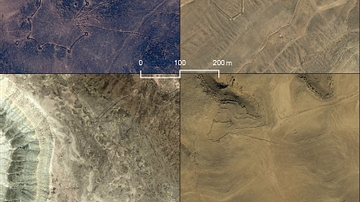
Desert Kites
Extracts of satellite images from Google Earth and Bing of kites from the Harrat-al-Sham in Jordan (above left), Qaratein area in Syria (above right), Ustyurt Plateau in Kazakhstan (bottom left) and the mountains of Palmyre in Syria...
Image
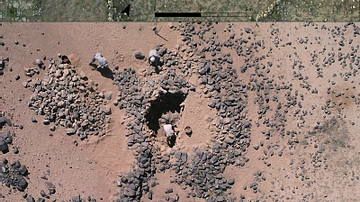
Desert Kite Cell
A cell at the extremity of a pointed appendice from a kite in Armenia (up). The same
configuration in Jordan, a cell under excavation (down).

Article
Armour in Ancient Chinese Warfare
With zinging arrows, powerful crossbow bolts, stabbing swords, and swinging axes all a staple feature of the Chinese battlefield, it is not surprising that soldiers sought to protect themselves as best they could...

Collection
Ancient Roman Warfare
With a huge reserve of resources in men and equipment and a culture geared for warfare, the Romans were relentless in expanding their borders and putting their neighbours to the sword. The Roman army, with its well-trained...

Definition
Siege of Tobruk
The siege of the port of Tobruk in Libya (April to Dec 1941) by Axis forces during the Second World War (1939-45) lasted 242 days and became a symbol of Allied resistance. Besieged by land but still supplied by sea, Tobruk was...
Image
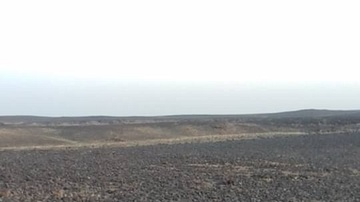
Al Harr'a or Jordan Desert
The Jordan Desert, aka Al Harr’a Desert, the location of many c. 1000 BCE Safaitic inscriptions.
Image
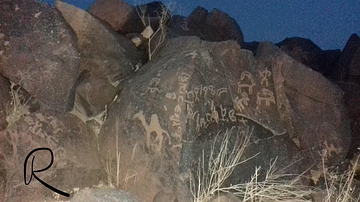
Safaitic Inscriptions in the Jordan Desert
Safaitic inscriptions on basalt rocks. 1st century BCE to 4th century CE. Jordan Desert or Al Harr’a.
Image
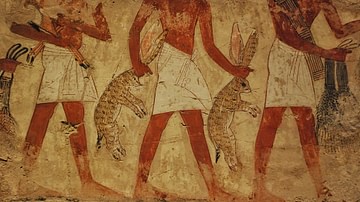
Egyptian Desert Hare Hunting
An Egyptian servant is carrying two desert hares as an offering to Nebamun, a rich Egyptian accountant. Detail of a larger procession of agricultural offerings, from the tomb of Nebamun (c. 1350 BCE). The British Museum...
