
Search
Did you mean: Cyclades?
Remove Ads
Advertisement
Search Results

Article
A Visual Who's Who of Greek Mythology
Achilles The hero of the Trojan War, leader of the Myrmidons, slayer of Hector and Greece's greatest warrior, who sadly came unstuck when Paris sent a flying arrow guided by Apollo, which caught him in his...

Definition
Greek Mythology
Greek mythology was used as a means to explain the environment in which humankind lived, the natural phenomena they witnessed and the passing of time through the days, months, and seasons. Greek myths were also intricately connected...

Image
Odysseus Escaping Polyphemos
A scene from a Greek black-figure pottery vase showing the hero Odysseus tied to a sheep as a means of escape from the cyclops Polyphemos. Unknown date. (Mykonos Archaeological Museum)
Image
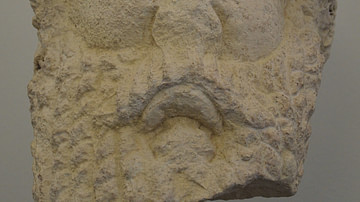
Head of Polyphemus
Head of Polyphemus, a one-eyed Cyclops, from the amphitheatre at Salona, 4th century CE.
Split Archaeological Museum.

Definition
Chitrali Mythology
Chitrali mythology developed in the region of Chitral, the tallest portions of the Hindu Kush mountains, where the Chitrali people, at the juncture of South, Central, West, and East Asia, were exposed to many external cultural...

Definition
Homer
Homer (c. 750 BCE) is perhaps the greatest of all epic poets and his legendary status was well established by the time of Classical Athens. He composed (not wrote, since the poems were created and transmitted orally, they were not written...

Definition
Tyche
In Greek mythology, Tyche is the goddess and personification of good luck, chance, and fortune. Tyche's popularity grew after the Classical period when many cities and officials across the Greek world and the Mediterranean adopted her...

Definition
Euripides
Euripides (c. 484-407 BCE) was one of the greatest authors of Greek tragedy. In 5th century BCE Athens his classic works such as Medeia cemented his reputation for clever dialogues, fine choral lyrics and a gritty realism in both his...

Article
The Life of Antisthenes of Athens in Diogenes Laertius
Antisthenes (c. 445-365 BCE) was a Greek philosopher who founded the Cynic School of Athens. He was a follower of Socrates and appears in Plato's Phaedo as one of those present at Socrates' death...

Definition
Pluto
Pluto is the god of the Underworld in Roman mythology. His Greek counterpart was Hades. Pluto chose never to sit on Olympus with the other gods and goddesses, preferring to remain in the Underworld. Family Pluto (Hades) was the son...
