
Search
Remove Ads
Advertisement

 This answer was generated by
 Search Results
Image
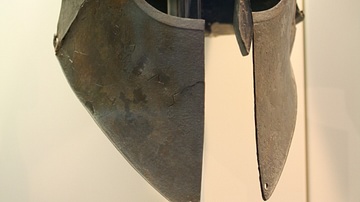
Corinthian Helmet
A bronze 'Corinthian' helmet (6-5th century BCE). Olympia Archaeological Museum.

Image
Corinthian Helmet (Detail)
Detail of a Corinthian helmet, from the second half of the 6th century BCE. The decoration of the helmet suggests that it may have been produced in central Italy. Louvre Museum, Paris, France.
Image
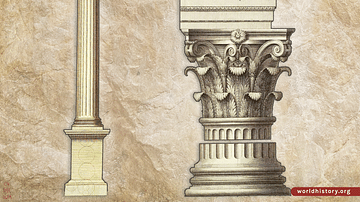
The Corinthian Order, Classical Orders of Architecture
The Classical Orders of Architecture (Doric, Ionic, Corinthian, Tuscan, and Composite), originating in ancient Greece and refined by the Romans, are fundamental design principles that significantly...
Image
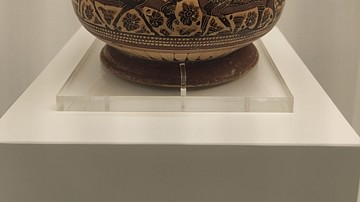
Corinthian Black-Figure Pyxis
This black-figure pyxis is decorated with ibexes and felines. This type of vessel was used as a container for cosmetics or jewellery. The decorative subjects, the elongation of the body of the animals and the schematisation...

Article
Paul's Journeys and the Mediterranean Trade
Mediterranean trade increased exponentially at the turn of the first millennium. During Rome's zenith, goods of all sorts began to move in all directions. As a common traveler aboard merchant ships, Paul...
Image
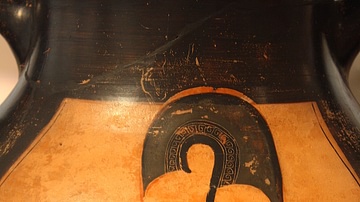
Greek Helmet with Myrtle Leaves
A depiction of a Greek Corinthian helmet with myrtle leaves. From an Attic black-figure pottery vessel from Phalero, 575-550 BCE. (National Archaeological Museum, Athens)

Image
Corinthian Capital
A corinthian capital, situated in the Agora of Athens.
Image
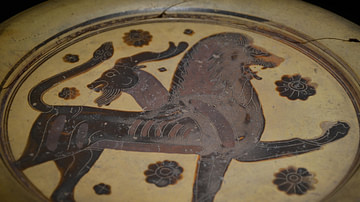
Chimera, Corinthian Plate
Corinthian plate with Chimera, 590-575 BCE.
Photo taken at the "Monsters. Fantastic Creatures of Fear and Myth" exhibition, Palazzo Massimo alle Terme, Rome in 2014.

Image
Corinthian Vessel with Protome
A Corinthian vessel depicting animals and carrying a protome of a female head on the handle, c. 570 BCE. (Getty Villa, Malibu).
Image
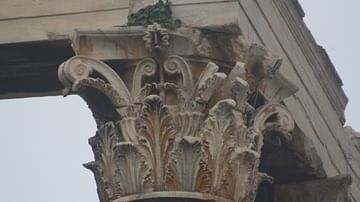
Corinthian Capital, Temple of Zeus, Athens
A Corinthian capital from the Temple of Olympian Zeus, Athens. Completed 131 CE.
