
Search
Did you mean: Norns?
Remove Ads
Advertisement
Search Results

Definition
Colosseum - Rome's Great Flavian Amphitheatre
The Colosseum or Flavian Amphitheatre is a large ellipsoid arena built in the first century CE by the Flavian Roman emperors of Vespasian (69-79 CE), Titus (79-81 CE) and Domitian (81-96 CE). The massive...

Definition
Mauretania
Mauretania was an ancient kingdom in northwest Africa, encompassing regions of modern-day Morocco and Algeria. Although it shares a name with the modern country of Mauritania, they do not overlap. Ancient Mauretania was named after...

Definition
Nike - Greek Goddess of Victory
The ancient Greek goddess Nike was the personification of the ideal of victory. Such personifications of ideal terms were common in ancient Greek culture; other examples include Wisdom, Knowledge, and Justice. Unlike...

Definition
Roman Art
The Romans controlled such a vast empire for so long a period that a summary of the art produced in that time can only be a brief and selective one. Perhaps, though, the greatest points of distinction for Roman art are its very diversity...

Definition
Persis
Persis (in Greek, derived from Persian pars) is the ancient name of the approximate area of modern Fars in Central Iran, as well as a state of the Hellenistic and Imperial periods in this same province. Its name is derived from the Persians...

Definition
Tyche
In Greek mythology, Tyche is the goddess and personification of good luck, chance, and fortune. Tyche's popularity grew after the Classical period when many cities and officials across the Greek world and the Mediterranean adopted her...

Definition
Parthian Art
Parthian art flourished within the Eurasian cultural corridor from the late hundreds BCE to the early 1st and 2nd centuries CE. With the Parthian Empire (247 BCE - 224 CE) stretching from India and China in the east to the Mediterranean...

Definition
Spanish Treasure Fleets
From the 16th to 18th centuries, two treasure fleets sailed each year, one to Mexico and the other to Central America, then part of the Spanish Empire. There they collected precious eastern goods and the riches of the Americas...
Definition
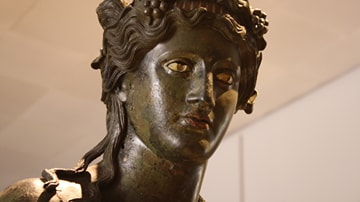
Dionysos
Dionysos (Roman name: Bacchus, also known as Dionysus) was the ancient Greek god of wine, merriment, and theatre. Being the bad boy of Mt. Olympus, Dionysus was perhaps the most colourful of the Olympian Gods. Son of Zeus In Greek...

Definition
Birka
Birka, located on the island of Björkö in present-day Sweden, was an important trading center and strongly fortified town in the Viking Age which flourished from the 8th through the 10th centuries CE. Along with the town of Hedeby which...
