
Search
Did you mean: Norns?
Remove Ads
Advertisement
Search Results

Definition
Antinous
Antinous (l. c. 110-130 CE) was a youth of Bithynia who became the beloved of the Roman emperor Hadrian (l. 76-138 CE, r. 117-138 CE) from around the age of 13 until his death at nearly 20. His year of birth is unknown as are any details...

Article
Paper in Ancient China
The widespread use of paper and printing were features of ancient China which distinguished it from other ancient cultures. Traditionally, paper was invented in the early 2nd century CE, but there is evidence it was much...
Article
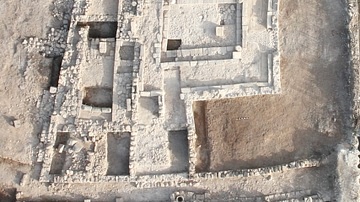
The Archaeological Excavations at Magdala
Magdala, known as Migdal in Hebrew (מִגְדָּל: tower) and also as Taricheae (Ταριχέα, from the Greek Τάριχος or tarichos: preserved by salting or drying fish), was an important fishing town during the first...

Article
Ai Khanum, the Capital of Eucratides
Ai Khanum (also spelled Ai-Khanoum or Ay-Khanum, lit. “Lady Moon” in Uzbek), was founded in the 4th century BC, following the conquests of Alexander the Great and was one of the primary cities of the Greco-Bactrian...
Image
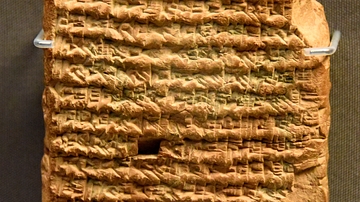
Babylonian Tablet Mentioning Coin Payments
This tablet records the exact coins required for transaction in Babylon. Because coins could circulate for many years, freshly minted coins were less worn and had a better silver weight. The tablet specifies...

Image
The Taranto Hoard
Southern Italy and Sicily had no silver and had to import it to mint coins. Hoards found there contain silver ingots and coins from the Eastern Mediterranean, as well as coins minted locally. This suggests that people there needed...

Article
Trade in the Byzantine Empire
Trade and commerce were essential components of the success and expansion of the Byzantine Empire. Trade was carried out by ship over vast distances, although for safety, most sailing vessels were restricted to the...
Article
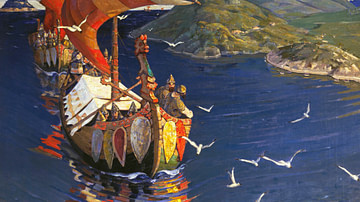
Trade & Warfare in the Kievan Rus
Scandinavians from the island of Gotland began to spread throughout the Baltic region along the Russian rivers in the 700s. While the Vikings of Norway and Denmark from the 8th to 11th centuries are widely recognized...

Article
Trade in Ancient Mesopotamia - How Commerce Encouraged Civilization
Local trade in ancient Mesopotamia began in the Ubaid period (circa 6500-4000 BCE), had developed into long-distance trade by the Uruk period (circa 4000-3100 BCE), and was flourishing by...

Article
Colchis & Iberia in Antiquity
Colchis (western Georgia) and Kartli/Iberia (eastern and southern Georgia) were important regions in the Caucasus area of Eurasia from the Bronze Age of the 15th century BCE. Prospering through agriculture and trade...
