
Search
Remove Ads
Advertisement
Search Results

Article
Global Trade in the 13th Century
In the 13th century, astonishing quantities of spices and silk passed from the Far East to Europe. Exact amounts are not known, but spice popularity in both cuisine and medicine reached its historical peak during...
Definition
Kappa
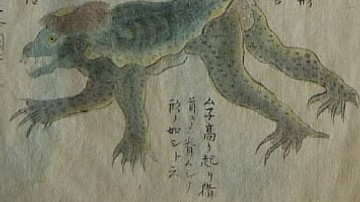
A kappa is a Japanese mythological water sprite or, literally, "river child" (河童). One of the more popularly known yōkai (Japanese mythological creature) in Japan, kappa are generally green or yellow, have a tortoise-like shell on their...

Definition
Ancient Korean Sculpture
The sculpture of ancient Korea was dominated by Buddhist themes such as figurines and monumental statues of the Buddha and his followers, and large bronze bells for temples. Gilded-bronze was the most common material used...

Definition
Religion in the Ancient World - Order and the Spiritual Experience
Religion (from the Latin Religio, meaning "restraint," or Relegere, according to Cicero, meaning "to repeat, to read again," or, most likely, Religionem, "to show respect for what is sacred"...
Article
Illness and medicine in Roman Britain
Although medical science was still in its infancy during Roman times, knowledge of medicinal plants was widespread and sick people may have been treated with herbal remedies by relatives and friends. Environment...

Definition
Emperor of Japan
The emperor of Japan is a position as the head of state which traditionally dates back to the 7th century BCE and the legendary figure of Emperor Jimmu (r. 660-585 BCE). Emperors came to be known as the Tenno or 'heavenly sovereign'...

Definition
Samguk Yusa
The Samguk yusa ('Memorabilia of the Three Kingdoms') is a 13th-century CE text which covers the history and legends of Korea's founding right up to the 10th century CE. It is a sequel of sorts to the earlier Samguk sagi ('Records...

Definition
Korean Pottery
The pottery of ancient Korea stretches back to prehistory when simple brown wares were made and decorated with geometrical incisions. Potters would benefit from the ideas and techniques of their Chinese counterparts and go on to...

Definition
Nara Period
The Nara Period (Nara Jidai) of ancient Japan (710-794 CE), so called because for most of that time the capital was located at Nara, then known as Heijokyo, was a short period of transition prior to the significant Heian Period. Despite...

Definition
Kinkakuji
Kinkakuji Temple in Kyoto, Japan, more formally referred to as Rokuon-ji or 'Deer Garden Temple' and otherwise known as 'The Temple of the Golden Pavilion', was first built in 1397 CE. Originally the retirement residence of the shogun...
