
Search
Remove Ads
Advertisement
Search Results

Article
Ming Taxation & the Silver Economy
The rulers of China's Ming dynasty (1368-1644) acquired an insatiable desire for silver in the 16th century, largely to pay for huge prestige projects like building the Forbidden City in Beijing and repairing the...

Interview
Rubin Museum's Faith and Empire: Tibetan Buddhist Art
Faith and Empire: Art and Politics in Tibetan Buddhism, a new exhibition at the Rubin Museum of Art in New York, explores the dynamic historical intersection of politics, religion, and art as reflected...

Definition
Iranian Revolution
The Iranian Revolution (1978-1979) was the social movement that arose from widespread and diverse discontent with the monarchic government of Iran. The revolution was fought against the regime of Mohammad Reza Shah (r. 1941-1979...

Article
Mulan: The Legend Through History
Mulan (“magnolia”) is a legendary character in Chinese literature who is best known in the modern day from the Disney filmed adaptations (1998, 2020). Her story, however, about a young girl who takes her father's...

Collection
Chinese Philosophy
Ancient Chinese Philosophy developed during the Spring and Autumn Period (c. 772-476 BCE) and the Warring States Period (c. 481-221 BCE) in ancient China. This was the era known as the Hundred Schools of Thought, referring to...

Definition
Meiji Period
The Meiji period refers to the period in Japanese history from 1868 to 1912 during which the Meiji Emperor reigned. Following the overthrow of the Tokugawa shogunate in the Meiji Restoration of 1868, Japan's new leaders embarked...

Definition
White Huns (Hephthalites)
The White Huns were a race of largely nomadic peoples who were a part of the Hunnic tribes of Central Asia. They ruled over an expansive area stretching from the Central Asian lands all the way to the Western Indian Subcontinent...
Article
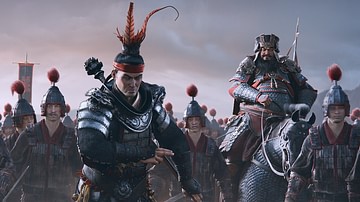
The Early Three Kingdoms Period
The Early Three Kingdoms Period in ancient China, from 184 CE to 190 CE for the purposes of this article, was one of the most turbulent in China's history. With an ailing Han government unable to control its empire...

Definition
Wu Zetian
Empress Wu Zetian (Empress Consort Wu, Wu Hou, Wu Mei Niang, Mei-Niang, and Wu Zhao, l. 624-705 CE, r. 690-704 CE) was the only female emperor of Imperial China. She reigned during the Tang Dynasty (618-907 CE) and was one of the most...

Article
South Carolina Declaration of Secession - Why South Carolina Left the Union
On 20 December 1860, 169 delegates met in Institute Hall in Charleston, South Carolina, to consider the motion of secession from the United States of America. They voted unanimously...
