
Search
Remove Ads
Advertisement
Search Results

Definition
Kublai Khan
Kublai Khan (Qubilai-Qan) was the ruler of the Mongol Empire from 1260 to 1294. His accomplishments include establishing Mongol rule in China under the name of the Yuan Dynasty (1271-1368), thus becoming the first non-Chinese to rule...

Article
Chariots in Ancient Chinese Warfare
The chariot was used in Chinese warfare from around 1250 BCE but enjoyed its heyday between the 8th and 5th century BCE when various states were constantly battling for control of China. Employed as a status symbol...

Article
Fortifications in Ancient Chinese Warfare
While ancient Chinese warfare was often characterised by large armies in pitched battles, siege warfare and the sacking of cities were also regular features. Huge earth walls with towers and encircling ditches...

Article
Armour in Ancient Chinese Warfare
With zinging arrows, powerful crossbow bolts, stabbing swords, and swinging axes all a staple feature of the Chinese battlefield, it is not surprising that soldiers sought to protect themselves as best they could...

Article
The Dragon in Ancient China
Dragons appear in the mythology of many ancient cultures but nowhere else in the world was the creature quite so revered as in China. There, in marked contrast to other world mythologies, the dragon was almost always...
Article
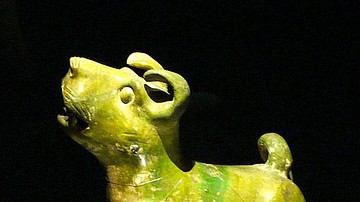
Dogs in Ancient China
Dogs are the oldest domesticated animal in China and were bred as guardians, for transporting goods, for herding, hunting, and as a food source. Archaeological evidence dates the domestication of the dog in China at approximately...

Definition
Confucianism
Confucianism is a philosophy developed in 6th-century BCE China, which is considered by some a secular-humanist belief system, by some a religion, and by others a social code. The broad range of subjects touched on by Confucianism...

Definition
Ming Dynasty
The imperial Ming dynasty ruled China from 1368 to 1644. It replaced the Mongol Yuan dynasty which had been in power since the 13th century. Despite challenges from abroad and within, the Ming dynasty oversaw an unprecedented growth...
Definition
Han Dynasty
The Han Dynasty (202 BCE - 220 CE) was the second dynasty of Imperial China (the era of centralized, dynastic government, 221 BCE - 1912 CE) which established the paradigm for all succeeding dynasties up through 1912 CE. It succeeded...

Definition
Teng Shih
Teng Shih (l. c. 500 BCE) was a Chinese Sophist and lawyer who lived and wrote in the province of Cheng (Pengcheng, modern-day Xuzhou, Jiangsu province) during the era of the Spring and Autumn Period (c. 772-476 BCE) which preceded...
