
Search
Remove Ads
Advertisement
Search Results

Definition
Ancient Greece
Greece is a country in southeastern Europe, known in Greek as Hellas or Ellada, and consisting of a mainland and an archipelago of islands. Ancient Greece is the birthplace of Western philosophy (Socrates, Plato, and Aristotle...

Definition
Bronze Age Aegean
The Bronze Age (c. 3000-1000 BCE) is the period when cultures were either using, producing, or trading bronze. Several cultures flourished around the Aegean Sea during this period: the Minoan civilization on Crete, the Mycenaean...

Video
Chinese is NOT picture writing! - History of Writing Systems #5 (Determinatives)
Watch this ancient Chinese scribe figure out how to use a fixed set of characters to write limitless words in his language. How? By combining meaning writing (logographs) and...
Definition
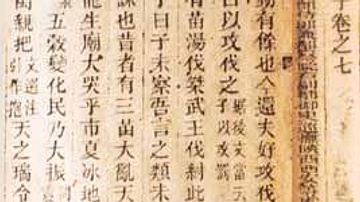
Mo Ti
Mo Ti (l. 470-391 BCE, also known as Mot Tzu, Mozi, and Micius) was a Chinese philosopher of the Warring States Period (c. 481-221 BCE) associated with the Hundred Schools of Thought (different philosophical schools which established...

Article
Eunuchs in Ancient China
Eunuchs were powerful political players in ancient Chinese government. Originating as trusted slaves in the royal household they were ambitious to use their favoured position to gain political power. Advising the emperor...

Definition
Silla
The Silla kingdom ruled south-eastern Korea during the Three Kingdoms period from the 1st century BCE to 7th century CE. The capital was Geumseong (Gyeongju) with a centralised government and hierarchical system of social ranks. The prosperity...

Definition
Seven Lucky Gods
In Japanese folklore the Shichifukujin are the Seven Lucky Gods who may also be known as the Seven Gods of Happiness or the Seven Gods of Good Fortune. The seven gods are in fact of diverse origin as some are originally from Buddhism...
Definition
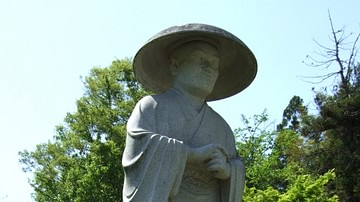
Ennin
Ennin (c. 793-864 CE, posthumous title: Jikaku Daishi) was a Japanese Buddhist monk of the Tendai sect who studied Buddhism at length in China and brought back knowledge of esoteric rituals, sutras, and relics. On his return, he published...

Definition
Sejong the Great
King Sejong the Great (15 May 1397 to 8 April 1450 CE) ruled Korea from 1418 to 1450 CE as the fourth king of the Joseon Dynasty (also spelled Choson). One of only two Korean kings called 'the Great' today, Sejong had a major...

Definition
The Secret History of the Mongols
The Secret History of the Mongols is a chronicle written in the 13th century CE (with some later additions) and is the most important and oldest medieval Mongolian text. The book covers the origins of the Mongol...
