
Search
Remove Ads
Advertisement
Search Results

Definition
Charles Vane
Captain Charles Vane was an English pirate active in the Caribbean and off the east coast of North America between 1716 and 1720. The pirate, who infamously refused a pardon and instead fired his cannons at the ship of Governor Woodes...

Definition
Marie de France
Marie de France (wrote c. 1160-1215 CE) was a multilingual poet and translator, the first female poet of France, and a highly influential literary voice of 12th-century CE Europe. She is credited with establishing the literary...

Article
Why Did Britain & France Appease Hitler?
The policy of appeasement towards the demands of Adolf Hitler (1889-1945) regarding Nazi Germany's territorial expansion ultimately failed when the Second World War (1939-45) began. The reasons appeasement...

Article
The Three Estates of Pre-Revolutionary France
Society in the Kingdom of France in the period of the Ancien Regime was broken up into three separate estates, or social classes: the clergy, the nobility, and the commoners. These classes and their accompanying...
Article
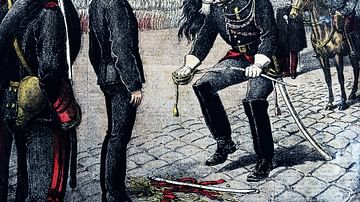
The Dreyfus Affair & the Separation of Church and State in France
The Dreyfus Affair, or L'Affaire as it has become known, demonstrated the competing forces at work to either reestablish the monarchy and the Church in power or to solidify and advance the...

Article
France’s 1905 Law of Separation of Church and State
The 1905 Law of Separation of Church and State was enacted as the climax of decades of conflict between monarchists and anticlerical Republicans who viewed Christianity as a permanent obstacle to the...

Image
Charles VIII of France
King Charles VIII of France (1470-1498), oil on panel portrait after an original by artist Jean Perréal (c. 1455 to c. 1528), 16th century.
Musée de Condé, Chantilly.

Image
The Comte d'Artois, Later Charles X of France
Charles Philippe de France, comte d'Artois (1757-1836), during the French Revolution, oil on canvas painting by Henri-Pierre Danloux, 1798. As the youngest brother of King Louis XVI, Artois was one of...
Article
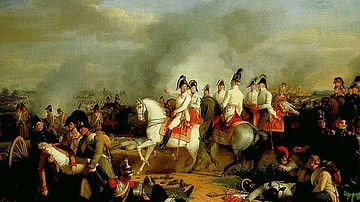
Battle of Aspern-Essling
The Battle of Aspern-Essling (21-22 May 1809) was a major battle of the Napoleonic Wars (1803-1815). It saw an Austrian army under Archduke Charles defeat a French army led by Emperor Napoleon I (r. 1804-1814; 1815) as...

Article
Architects of France's 1901 Law of Associations
The Law of Associations was adopted by the French Parliament on 3 July 1901 to limit the influence of Catholic teaching orders as the first step toward the formal separation of church and state that would...
