
Search
Remove Ads
Advertisement
Search Results
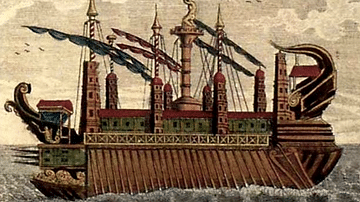
Definition
Syracusia
The Syracusia was an ancient sailing vessel designed by Archimedes in the 3rd century BCE. She was fabled as being one of the largest ships ever built in antiquity and as having a sumptuous decor of exotic woods and marble along with...

Definition
Twelve Tables
The Twelve Tables (aka Law of the Twelve Tables) was a set of laws inscribed on 12 bronze tablets created in ancient Rome in 451 and 450 BCE. They were the beginning of a new approach to laws which were now passed by government...

Definition
Great Pyramid of Giza
The Great Pyramid of Giza is a defining symbol of Egypt and the last of the ancient Seven Wonders of the World. It is located on the Giza plateau near the modern city of Cairo and was built over a twenty-year period during...

Definition
Kamakura Period
The Kamakura Period or Kamakura Jidai (1185-1333 CE) of medieval Japan began when Minamoto no Yoritomo (1147-1199 CE) defeated the Taira clan at the Battle of Dannoura in 1185 CE. The period is named after Kamakura, a coastal...

Definition
Arsacid Dynasty of Armenia
The Arsacid (Arshakuni) dynasty of Armenia ruled that kingdom from 12 CE to 428 CE. A branch of the Arsacid dynasty of Parthia, the Armenian princes also played out a prolonged balancing act by remaining friendly to the...

Definition
Persian Immortals
The Ten Thousand Immortals were the elite force of the Persian army of the Achaemenid Empire (c. 550-330 BCE). They formed the king's personal bodyguard and were also considered the shock troops of the infantry in Persian warfare...

Definition
Umar
Umar ibn al-Khattab (r. 634-644 CE) was the second caliph of the Rashidun Caliphate (632-661 CE, as the first four caliphs are referred to by the Sunni Muslims). He was an early convert of Islam and one of the close companions of the Islamic...

Definition
William Cecil, Lord Burghley
William Cecil, 1st Baron Burghley (1520-1598 CE) was Elizabeth I of England's most important minister for much of her reign (1558-1603 CE). Lord Burghley was Secretary of State for both Edward VI of England (r. 1547-1553...

Definition
Isaac Newton
Isaac Newton (1642-1727) was an English mathematician and physicist widely regarded as the single most important figure in the Scientific Revolution for his three laws of motion and universal law of gravity. Newton's laws became...

Definition
Jean-Jacques Rousseau
Jean-Jacques Rousseau (1712-1778) was a Swiss philosopher whose work both praised and criticised the Enlightenment movement. Although a believer in the power of reason, science, and the arts, Rousseau was convinced that a...
